Nissan turns over new Leaf
First electric car
Cloud storage: Lower cost and increase uptime
Leccy Tech Nissan has whipped the dust sheets off its first electric car.
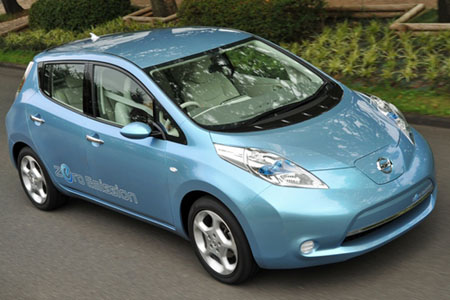
Nissan's first electric car, Leaf, will arrive in the UK during 2011
The curiously named Leaf is goes on sale in Japan and across North America next year. Nissan UK has confirmed to Register Hardware that the car will breeze into Blighty during 2011.
Technically, the Leaf is very similar to Nissan’s recently unveiled EV-11 systems development prototype. So we’re talking about a five-door, front-wheel drive hatchback powered by a single 80kW (107bhp) electric motor and connected to a 24kWh laminated lithium-ion battery pack.
With exterior dimensions of 4.4m x 1.7m x 1.5m, the Leaf is considerably longer and wider than Mitsubishi's iMiEV - which is likely to be the only e-car competition the Leaf will face when it goes on sale in the UK.
Leaf can reach a maximum speed of over 90mph and will keep going for roughly 100 miles from a full charge, Nissan says, With 280Nm (208lb/ft) of torque on tap, acceleration should be pretty brisk.
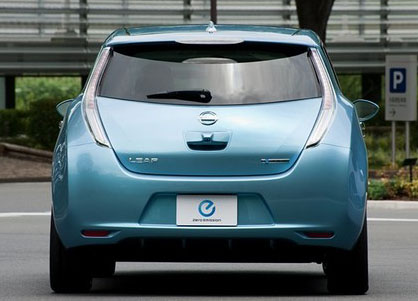
Leaf can go for 100 miles on a full charge
The 200kg (440lb) 192-cell battery pack sits under the floor, which gives the car an almost flat underside. As with the iMiEV, the Leaf has several recharge options: you can pop open the small charge cover on the bonnet, or you can connect the Leaf to a domestic 240v socket or 50kW DC off-board fast charger.
Using the 240v option will fully charge Leaf’s battery in about eight hours. However, using 50kW option will put 80 per cent capacity into the car’s battery in under 30 minutes.
Inside the Nissan electric vehicle you’ll find an advanced communications and navigation system, which connects the car to a global data centre for 24-hour “support, information and entertainment”.
Leaf’s dash-mounted display shows the car’s remaining battery power and the locations of nearby charging facilities.
Nissan hasn’t said how much Leaf will cost, beyond promising that a competitive priced C-segment vehicle. So you could expect to pay something in the region of £20,000 ($33,400/€23,450), before any government rebates or subsidies. ®
COMMENTS
I forsee...
...a booming breakdown + recovery business when folks run out of charge or go out on the last 10% forgetting they have to go uphill to come home :D
And +1 to AC - NO to parking fees. If they really want people to use less fuel and cause less congestion they can at least support people a _little_ bit. The government is meant to work for US ffs, not the other way around. The whole parking system is a joke in most places, anyway.
Power rails
@Dani Eder, Rather than rails how about induction circuits? These could be completely covered up by the road surface but still charge the car as you drive.
Having said that I still believe the way fall ward is compressed air. Making a compressed air car to do 500 miles is not unthinkable and 3 minute fill times mean you could use existing garages with additional pumps. Compressed air will not be lost when the car is parked at the side of the road and off course you use electricity to compress the air. As most cars are parked at the side of the road any system that is dependent on charging the car at home will always have a small market.
Syd also made a valid point. I have been fighting Westminster Council (see notobikeparkingfees.com) for the last year who having seen a rise in the number of motor bikes used to commute into Westminster and so have started charging to park them. While government allows councils to adopt a myopic view of the world that ends at their boarders new ideas like this will always fail. The government needs to take control of curb side parking and not let councils make as all pay for council tax in areas of the country we don’t live in. Westminster Council will make £ 4M in the first year from motor bikes alone and who knows what from cars.
Mines the one with the No To Bike Parking Fees high vis. vest on.
AC because of the compay I work for.
Not your only car
If you;re looking for ranges of 300-500 miles, this is not the car for you (or not your ONLY car). Leccy cars are intended FOR COMMUTERS and daily travel around town.
Granted, with access to 50Kw charging stations, which should not be hard to find one every 100 miles or so espacially with the onboard system to automatically assist you there, and 20-30 minute charge times, that's not bad. However, this is a starting point, its NOT the car for everyone.
For people needing longer ranges with infrequent occasion, a Chevy Volty or equivalent, Leccy car with gas generator onbaord, can run about 400 miles on a small tank. For people who travel more than 100 miles a day on average, one of these might do, or you might just have to wait and stick to deisel...
In a few years (2 tops) these cars will be shipping with LiTi batteries instead of LiIon, getting double the range, and charge times in the 8-10 minute range. Hell, every 200 miles I'm at least going to need to piss, and 8 minutes to wait for a recharge wild draining the lizard is not a bad proposition to be able to run at 1/3rd the cost of gasoline.
Also, the $33k per car figure should drop significantly over the next few years. It;s priced there partly because of the $12-15K cost of the battery pack, and partly because people just want em, and they're not making that many yet... Batery producers are expecting 30% anual reductions in cost/Kw stored. The LiTi batteries (and other up and coming combinations) are stabler, charge faster, have longer lifecycles, are cheaper to make (lots cheaper), and pack more energy into the same space weight or both.
Let the first takers burn some extra green trying to be green. Pick up your Leccy in 2-3 years and you'll likely pay under $20K, charge in under 15 minutes to 80%, and get double the range....
Of course, even if we could make the perfect Leccy car in the next 5 years, at a price every one of us would be stupid not to buy, we can't. The grid is 20-30 years from being able to support even 10% of us driving around in these. today is 3% of us switched, we would fry the grid. There's simply not that much electricity being made atm.

Agentless Backup is Not a Myth
Steps to Take Before Choosing a Business Continuity Partner
Requirements Checklist for Choosing a Cloud Backup and Recovery Service Provider
Cloud storage: Lower cost and increase uptime
SaaS data loss: The problem you didn’t know you had