


This article is more than 1 year old
Microsoft's Bing feeds you, tries to keep you captive
Fully featured Google inertia beater?

Review Considering the amount of time, money and effort that's gone into Bing, Microsoft's made some truly odd decisions in connection with its new search engine.
Never mind the odd name. Did Microsoft really not foresee that Bing could be used as a handy way to side-step porn filters? And was it really necessary to bolster Wikipedia's position as the web's number-one source of truthiness?
But the real question is: How does Bing rate as a search engine? Search has been one of Microsoft's biggest failures. The company has just 5.5 per cent market share compared to Google's 81.5 per cent, even though Internet Explorer remains the most popular browser and defaults to Live Search.
Bing is the latest attempt to win back some users. It is not just a rebranding exercise. Although the core Live Search index remains the same, Microsoft has introduced a new way of categorizing results that affects the ranking of results as well as new features in the user interface.
Microsoft is rolling out Bing gradually. The US gets the full Bing experience now, but most of the world does not. In the UK, for example, Bing is in beta. "We've been announcing our brand," explains UK product manager Marie Thirlwall, "but we are not releasing the whole categorized experience. That will be a beta for the next six to nine months."
This review is based mainly on the US Bing, which Microsoft says is feature complete.
Whereas Live Search seemed to imitate Google's sparse home page, Bing tries to be different. It sports a background image with rollover hotspots, and currently changes daily. Gimmicky, but at least users will realise that Bing is not Google.
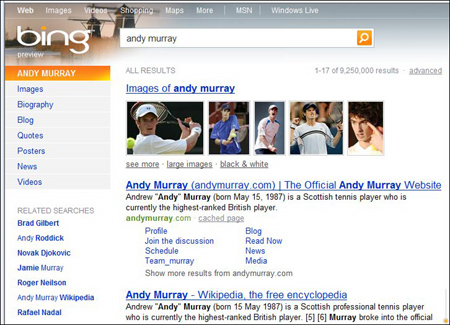
Searching for tennis pro Andy Murray returns a menu of categories to refine your results
The real change comes when you perform a search. If you happen to choose a Bing-optimised subject, such as the name of a celebrity, you get results sorted by category, along with a menu at the left that lets you refine your search with topics such as Images, Biography, Quotes and News. Search for a product such as an iPod, and you get categories including Shopping, Types, Buying Guide and Reviews. Microsoft calls these Web Groups, and although they only cover a small subset of possible searches, they are a key Bing concept that will be extended in future.
Microsoft calls Bing a decision engine. Why? "That's our goal of not just providing links but helping you solve the key task that you're trying to do," says Program Manager Nathan Buggia. "That's the whole point behind the categorised search, the instant answers, and a lot of other features."
Instant answers is a feature that aims to resolve your question without needing to leave Bing. Type "London weather", for example, and you get a summary of weather in London now and for the next five days.
Another Bing feature, Best Match, shows up when you perform a search with a highly predictable result. Type a company name, and it is a fair bet that you are looking for its official web site. Best Match shows this at the top of the results, with deep links into common destinations on that site, a telephone number, and sometimes a search box that likes to the search engine on the site itself.
 Biting the hand that feeds IT

