


This article is more than 1 year old
Who's afraid of the SOA police?
Just do it

Comment We heard a lot of talk a few months ago about about the death of service oriented architecture (SOA). This was mainly by the kind of pundits who had over-hyped it in the first place. Since then, we have seen various rebuttals to the claims that were made, but a degree of uncertainty about the status and role of SOA persists. So why the confusion?
Three factors are at play.
The first is the dominance of purism over pragmatism when defining SOA. Various analyst firms and consulting houses have come up with highly theoretical treatments and idealistic advice over the past few years, too often sneering at the efforts of those using service oriented principles on a selective tactical basis.
This is unhelpful. So what if, for example, you’ve embraced the concept of XML based services and standards, have wrapped some of your legacy systems in more open service oriented interfaces, but have not yet implemented an Enterprise Service Bus (ESB), or gone to town on software componentisation? Your systems are still more flexible and efficient, even though some would consider you not to have implemented ‘proper SOA’.
Moment…um
The second cause of confusion was the vendor community getting way ahead of the market in the early days, bigging up the level of SOA adoption and progress in an attempt to create the impression of market momentum. A problem then arose when the way in which real activity unfolded turned out to be different to the supplier spin.
While many vendors were talking three years ago about how SOA was being widely used to enable a better business dialogue, more collaborative working between IT and business stakeholders, etc (in the then present tense), the reality is that SOA today has been mostly embraced as a systems optimisation approach, predominantly applied within the IT domain.
With these points in mind, the only two things that have arguably died are the unrealistic expectations of the purists, and the notion of SOA being a strategic magic bullet as propagated by those with a vested interest.
The third factor to consider is the limited number of new organisations adopting SOA over the past year In a recent survey of around 600 readers of The Register conducted by Freeform Dynamics, the percentage of those considering or embracing SOA was pretty much the same as the equivalent survey conducted a year earlier. Considered in isolation, you could be forgiven for interpreting this apparent stalling as evidence of failure. But if this is true, then a number of other ‘hot’ propositions are failing too:
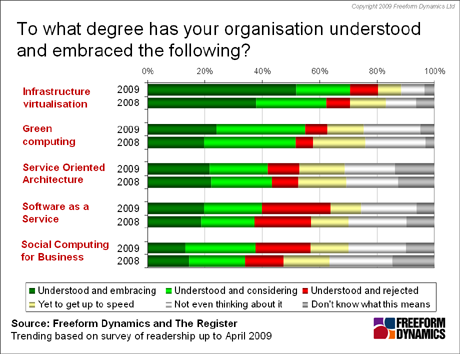
What we are seeing here is mostly the impact of the downturn. The green bars on this chart tell us that those having committed to newer concepts and ideas are generally not backing away from them. But, with the exception of infrastructure virtualisation, we are not seeing significant incremental adoption by those that have previously been inactive.
This is consistent with IT departments under financial pressure often being reluctant to start new strategic initiatives for fear of being unable to follow them through enough to generate a return on investment (ROI) in a relatively short period of time. This kind of behaviour is not something we would necessarily advocate, for the reasons discussed here. But it does reflect a common reaction to the budget squeeze being applied.
It also reflects the downside of pundits and vendors bigging up propositions too much. While elements of SOA can indeed be adopted selectively to deliver short term integration related benefits for example, over-positioning of the approach as a highly disruptive new way of doing things that goes to the heart of how IT is applied within business makes it sound totally inappropriate as something to embark on in an uncertain economy. No wonder we see reluctance among those who haven’t yet got their feet wet and worked out for themselves that SOA can potentially contribute at all levels - tactical as well as strategic.
So, if you are working in an environment in which a lot of development or integration activity takes place and you haven’t yet looked at how SOA can help, don’t be put off by a lot of the big talk you hear in the industry. Check it out and cherry pick the elements that will help you solve some immediate issues, as well as moving you in the right general direction, you don’t have to worry about the SOA police knocking on the door and telling you you’re not doing it right.
 Biting the hand that feeds IT

