The Register® — Biting the hand that feeds IT

Feeds

It's US vs Europe as world e-car plug standard race nears end

One ring-main to rule them all

Cloud based data management

'Leccy Tech It looks like the US, Europe and several of the world's major car manufacturers are set to agree on a standard power connector for plug-in e-cars. Or rather two standards: one for the new world, one for the old.

Due to be unveiled at a Hanover technology fair on Monday by German energy company RWE, the Euro plug uses three prongs and will support charging at up to 400V.

According to RWE, the new plug design has already been endorsed by Volkswagen, BMW, Ford, General Motors, Fiat, Toyota and Mitsubishi, along with power companies E.ON, Vattenfall, EDF, Npower, Endesa and Enel. Since RWE is working with Daimler-Benz on its “e-mobility Berlin” project, it's probably safe to assume that Mercedes – and thus Smart – will also be using the new connector.

However, across the Atlantic, a “task force” working on the J1772 EV plug standard will be meeting this week in Detroit during the Society of Automotive Engineers World Congress to continue its efforts to establish that as the industry standard.
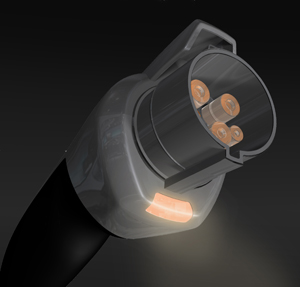
GM's J1772 e-car connector

The J1772: soon to be a US standard

According to reports from GM, which sponsors the J1772 task force, that standard has received thumb-ips from Chrysler, Ford, Toyota, Honda, Nissan and Tesla, the last having apparently agreed to retrofit the new socket to all the cars it has already built.

GM is, naturally enough, pushing for the J1772 to be adopted as the industry standard before its Chevrolet Volt is launched in November 2010.

At the moment, nobody seems entirely sure if the J1772 and RWE plugs are the same or not. We would assume not, as the J1772 seems only to handle single-phase systems up to 240V and 70A, while the RWE design can handle three-phase charging.

Neither standard is final at the moment, the SAE task force saying that it hopes to be finished this autumn, while RWE expects to be done sometime next year.

Transatlantic incompatibility notwithstanding, even this degree of harmonisation has to be welcomed at this early in the e-car development game. ®

SaaS data loss: The problem you didn’t know you had

Latest Comments
Anonymous Coward

@GrahamT

Predominating US distribution is 3-phase Wye into the neighborhod and to feed 4-10 households from one step-down transformer connected to just one of the phases (A, B, or C) and ground. The step-down creates two 180-degree opposite hot leads with a center-tapped neutral. Different than 120-degree shifts of real 3-phase. If one 100 Amp 7500 Volt fuse up the street blows it takes out only 1/3 of the neighborhood services by the step-downs on that phase.

0
0

@GrahamT

I didn't know about the septics using 2ph for their cookers. Although anyone setting such a standard as the plug should be familiar with the US 2nd level distribution network. You have to wonder, does the cost of such a plug change the price of an EV *that* much?

That the US would not adopt a European standard is a given. Choosing such a limited and inflexible design is above and beyond the duty of fail.

0
0
Anonymous Coward

3 prongs is not a good 3-phase solution

'Cause it doesn't provide any grounding. And if you really did it in a real petrol station sparks would fly just from static electricity. It would work only for 3-phase delta wired distribution which is pretty expensive to run in US over the "current" single phase (aka two phase) three wire (2 hot, 1 neutral) drops between the pole pig ( the two-part transformer referenced above) and the house. The J1772 drawing (assuming it is right), has 4 prongs showing and would support 3-phase delta or 3-phase wye with that long ground pin that makes contact drawing off static and safing the car apparatus before the hots do. Would suspect that EU standards committees will want to have more that 3 prongs if 3-phase is expected.

Of course 3-prongs is what is on the common US 115V/230V plugs which could work in EU also. Does the UK get standard plugs on their appliances yet?

And there are no real problems with making a car charge controller that can handle 100-450 Volts (100 being a typical Japanese voltage) and have it control how much current gets drawn from checking out the voltage and AC frequency on the hot plugs. (Did you know that Japan is reported to have 50Hz service on one part of the country and 60Hz in others?

Add another 8 cent timer chip to the onboard or household power sequencer controller and you could program it to charge only at 0000-0500 hours when there would be more excess capacity.

0
0

More from The Register

New material enables 1,000-meter super-skyscrapers
Before you read on, see if you can guess how the new stuff will be used
Boffins build headless robo-kitties
Soft kitty, warm kitty, cuddly little ball of wire kitty
 breaking news
Latest NASA ASTRONAUT class is HALF FEMALE
Newbie 'nauts include lady Marine fighter pilot, male doctor
 breaking news
You've seen the Large Hadron Collider. Now comes the HUGE Hadron Collider
International Linear Collider ready to rock and roll
Boffins find evidence Atlantic Ocean has started closing
'Embryonic subduction zone' that flattened Lisbon headed for Blighty
House bill: 'Hey NASA, that asteroid retrieval plan? Fuggedaboutit'
Republican-led committee also swings budget axe at climate science
Google launches broadband balloons, radio astronomy frets
A careless Loon could blind the square kilometre array
Hubble spies unlikely planet being born in hostile neighborhood
Hoovering a cloud of sand 7.5 billion miles from a tiny star
 breaking news
Jaguar to open new car-making factory in Blighty (virtually)
Britain still makes stuff, it's just not real any more...
 breaking news
Spin doctors brazenly fiddle with tiny bits in front of the neighbours
Quantum computer address bus just nanometres wide