Qualcomm startup punts '4th game console' for developing nations
Beating piracy with wireless distribution
GDC 09 A California-based startup backed by Qualcomm is launching a 3G-enabled home game console for emerging markets using hardware normally intended for high-end smartphones.
Zeebo unveiled what it describes as the industry's "fourth console platform" today at the Game Developers Conference in San Francisco. The company hopes to tap into new game markets like Brazil, Russia, China, and India, where low incomes and rampant piracy have kept most major console makers out.
Speaking at GDC, Zeebo's CEO Jon Rizzo said the console is a complete copy-protected, piracy-protected environment — which is the first hurdle to attracting game publishers to making localized, culturally relevant titles for the regions.
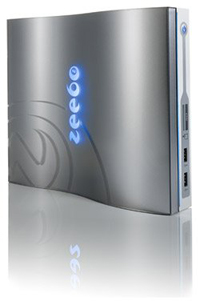
The Zeebo console uses Qualcomm's mobile MSM chipset and BREW developer platform to push budget game titles though a pre-paid, digital distribution model which includes plenty of phoning home to make sure the software that's running is legit.
Zeebo is scheduled to debut for about $200 in Brazil next week and will later head to Mexico, Eastern Europe, India in 2010, and China in 2011. Rizzo said the device will undercut the major consoles which have jacked up their hardware prices in emerging markets to counter scant software profits due to piracy. For instance, the Wii costs about $1,000 if you bought it legally in Argentina, according to Rizzo.
The system is about the size of a Nintendo Wii with graphics somewhere between a PS1 and PS2. Zeebo packs a 528MHz ARM 11 processor — the same CPU found in phones like Sony Ericsson's Xperia X1 and T-Mobile's Android G1 phone. Graphics is handled by a Qualcomm Adreno 130 integrated graphics core.
The system includes 1GB internal NAND flash memory (enough for 50 games), 128MB of DDR SDRAM, a gamepad, three USB 2.0 ports, and an SD slot. Max screen resolution is 640x480.
The game will launch with four pre-embedded games (FIFA 09, Need for Speed Carbon, Brain Challenge, and Prey Evil) and offer a free download of Quake. Digital downloads through the company's ZeeboNet 3G network is the only way content will be offered. There will be 15 games available on launch day, and 30 games within the first 90 days, according to Rizzo.
Zeebo will attempt to lure customers away from piracy by charging about $12 per game — around $2 more than the average game sold on the grey market. Each download must be prepaid before being authorized, and the game only will work with the user's unique subscription and console ID. Local partners will decide which games go on the console.
Publisher's that have already signed on include Namco, THQ, Capcom, EA, Activision, and ID Software. Rizzo hopes others will be attracted to Zeebo's minimal development costs and marketing requirements along with a promise of quashing piracy on the console. ®
COMMENTS
Fake me in the arse
I've been to Russia many a time. In fact I picked up tons of games off the market there for dirt cheap. No one will buy this shit console, they want the same games we have. They have the latest consoles but they are sold pre chipped (xbox 360 anyway) and the games are all pirated.
In Russia there is very little alternative to buying pirated software because they don't have the money to pay £30 for a game and there are very few places selling them.
If you go to a shopping mall I can guarantee all the shops selling music and games are pirated, but this goes further than games. Everything has the potential to be fake in Russia, cigarettes make up, clothes, trainers. I remember one time going down and people were talking about a facial cream that had been faked in the basement of a block of flats. In the city I go to they don't sell many Marlborough Lights any more because of excessive faking.
Its a national problem which effects most of the country outside of the big Cities like Moscow etc. but throwing in a shit console will make no difference at all. The people there aren't bothered with fakes they just see it as a means to an end and so I think they wouldn't go and buy this especially if its got the same processor as a mobile phone lol. The reason the fakes market is so big is because they all want to jump on the band wagon for the latest equipment, games, consoles at a price the public can afford.
Paris because she wouldn't be this shit console either!
@Filippo
Please direct your attention to the ":)" at the end of Nick's post. It isn't accidental punctuation.
What does a PS2 retail for in those markets now?
Gotta be able to sell it for way less than $200 at a profit.
In which case this new console offers:
a) lower specification,
b) fewer games (by at least 2 orders of magnitude, possibly 3)
c) requirement for internet/phone home in areas where that is sometimes tricky/impossible
d) more expensive games (even legally)
compared to a PS2.
Hmm. Mine's the one with the PS2 and thousands of games in the pocket.
Fail
In a so-called third-world country you are either rich enough that you can easily afford a Wii even if it's 1000 bucks, or so poor that even 200 is way beyond you.
Oh, and how do they want to sell a console that constantly wants to phone home if people have no broadband flatrates, or even reliable Internet? What about power outages?
If I was stuck in, say, Ethiopia, and I had 200 bucks to spend on a game console, I'd buy a PS2. Thousands of games out, all available for a buck (most even legally), doesn't need Internet (it's to slow for online gaming around my place anyway). Why spend money on something that is a brick when your online connection is down for a week?
Last thought: people in Europe, US, Japan don't pirate? The reason you sell more in these countries is because your demographic has more disposable income, not because they care about the law more.
Any time someone says "this has been designed for poor countries" ignore them unless:
a) it's useful in rich countries too
b) it's designed *by* people in a poor country *for* people in a poor country.
