Amazon does video game trade-ins
Targets GameStop, publishers
What you need to know about cloud backup
Amazon.com has wandered into the long-standing cold war between video game publishers and retailers dealing in used video-game trade-ins.

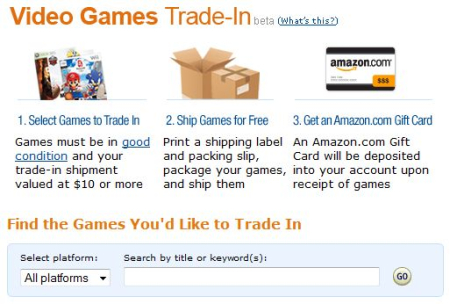
The online vendor on Thursday launched a new pilot program where customers can receive store credit in exchange for wide selection of popular hand-me-down games.
It's presently accepting over 1,500 titles for varying amounts of Amazon credit. Once users select a game they own and want to exchange, the site provides a pre-paid label to cover the cost of shipping. After Amazon verifies it's the right game and in "good condition" (not damaged, includes original packaging), the customer receives a shiny new gift card deposited into their account.
The beta program currently accepts games from most of this generation's current game consoles, yet oddly neglects the PC as a medium for exchange.
Exchanges appear to be done by a third-party dealer, referred to in Amazon's trade-in terms of service as "the Merchant." There doesn't appear to be any indication of who, specifically, the Merchant is. As of publication, Amazon hasn't responded to requests for clarification.
Presumably, the games will sold back to Amazon customers later down the line.
The resale war
Trading used games has long helped keep margins afloat for video game mega-chains like GameStop, in a market where profits on new titles can be extremely slim. But trade-ins have been a point of contention for publishers lately, who feel they're losing out on sales.
Some game makers have taken indirect steps to diminish the value of trade-ins with schemes like adding a unique, one-time code in the box for downloading "extra" content or by simply shackling the title in DRM restrictions.
Occasionally, game publisher frustration has boiled into the open, as seen with Gears of War maker Epic Games' president Michael Capps in an interview with Gameindustry.biz.
I'd hate to say my players are my enemies - that doesn't make any sense! But we certainly have a rule at Epic that we don't buy any used games - sure as hell you're not going to be recognised as an Epic artist going in and buying used videogames - because this is how we make our money and how all our friends in the industry make money.
Amazon joining the fray may also add considerable pressure on stores that specialize in game trade-ins. Not only does Amazon hold considerable clout as a retailer, but its store credit can be used to purchase a far greater variety of merchandise than GameStop's selection of more video games, dubbed anime, and the occasional special edition Boba Fett action figure.
Yet other major US retailers like Best Buy have failed in their attempts to wrestle GameStop's iron grip on the trade-in market with game exchange programs of their own. Best Buy's trade in service was operated by Dealtree.com, a site that handles auction management and returns processing for retailers. It's probably safe to assume a similar kind of business is responsible for Amazon's trade-in program as well, given the site's references to a third-party merchant in the program's literature.
Readers can check out Amazon's announcement here or browse the Amazon Trade-in Store over yonder.
As incentive, for the first two weeks of the program, Amazon will throw in a 10 per cent discount of a future purchase of any game or accessory in Amazon's video game store. ®
COMMENTS
physical media will not die
we will not lose physical media any time soon because:
* emerging markets need phsical media. india, eastern europe and south america are potentially huge markets but dont have the infrastructure for digital distribution.
* some people move residence often (eg students) making download only very unatractive
* many people have chaotic finances that do not allow for the monthly contracts broadband requires (look how popular PAYG mobiles are)
* gifting is a huge part of the games market. people want somthing to wrap up.
Secondhand is arguably helpful to the industry because:
* many people who buy full price games only because they know they can sell them on.
* many people who buy full price games relied on second hand when younger and poorer
* people will take risks on less mainstream games if they know they can trade them in.
* without second hand there would be few specialist game shops. leaving supermarkets selling just a smll range, very unhealthy.
back @ Stef (and beyond, and then some...)
Buying one MS Office disc & licence but installing it on more than one machine is entirely different to buying one game, playing it and then selling it (same goes for a CD or DVD or book). The other is legitimate supply and demand.
Which is why I made the point that copying games and selling on the disc is far less rampant than happens with CDs (and, to a lesser extent, DVDs). Yes there might be a problem with folk copying CDs DVDs (as CDR burns or mp3 rips). But as far as books go, no-one buys a book, photocopies it for keepsies, then sells the original on.
So the second hand market in games (and books) is a fairly genuine reflection of supply versus demand.
Your example of the book that sells one copy and then gets variously lent around and sold on is an analogy of p2p (something which infringes copyright). It does not describe the second hand games/books resale market (which is fairly overwhelmingly the legitimate resale and reuse of goods) where the "licence" is sold on with the disc/book itself so that someone might take some utility from the product in question.
I almost see what you're getting at by saying that in the situation where a book is bought and read by more than one person, one after another, then original sales of the book will stagnate. But that's how media entertainment works. It's not a once-only thing. It is a reusable copy of the original, for enjoyment by one person at any one point time (books - more at a push, if you're reading aloud!) or by one household at any one time time (CDs / DVDs / games) for personal consumption and non-profit purposes.
<what follows gently drifts away from the discussion in question and towards more theoretical territories where someone may well see fit to correct me>
Media exists because the original artist can't be in more than one place at once. Copyable formats are a medium for their distributing a copy of someone's talents. The author can't read to us all at once. The artist can't paint a picture for us all at once. The musician can't play for us all at once. Which brings us to DVDs. Most aren't exactly a filming of a theatrical production, are they? Things aren't so clear cut there. What of games? Well they never really existed in the first place. Which is why the dabate rages over whether they're actually art, or just toys. Whatever. They're (mostly) distributed on the basis of being intrinsically tied to the format that carries them. You buy "a game" rather than entry to the game. Though even that's not so clear cut when you consider the internet. MMORPGs (as I understand 'em - I have little experience) are much reliant on the characters and players. You don't so much buy the game, you buy into the creation the the game environment. And so the interactive nature of these games means that the role of creator leans back to the participants somewhat. Am I right in saying that in WoW you could sell the game disc+licence on but your character could be worth more than the game itself, so you could choose to (or not to) sell that on, too, for probably more than the game+licence itself? ... ... ...
@Stef
When you 'buy' a game or piece of software, you are not actually paying for anything more then a licence to use it. The fact that the publisher gives it to you on a CD/DVD is neither here nor there.
Seems like you either work for the industry or have bought into their bullshit. If I buy a single copy of something Then I am entitled to install it on a machine of my choosing. If I decide to uninstall it from one machine and put it on another then that is my right. If I want to sell it, that is also my right as long as I remove the product.
Just like buying anything - I buy it, I use it as I see fit, I sell it and can no longer use it. the courts have already ruled that by buying software you purchase it - not a license saying you are allowed to use it.
If software is licensed, then basically the publisher is renting it to me. If my original install media gets damaged they are obligated to provide me with another as they own it, not me. Instead, if my media get damaged I have to go and PURCHASE a full retail copy. No replacement media, no discount. That is my property - not the publishers.
If the software is merely licensed, then the price I pay is for a lifetime unless they specify a timescale. As such the publisher is legally required to support me for the life of the license. How many publishers do? After a set period of time they stop supporting it and my 'license' means nothing to them, so it really isn't a 'license' is it, it is a purchase and as such I am entitled to do whatever I like with it including reverse engineering the code. As long as I don't do anything to make that code available to anyone else I have acted perfectly legally as the law gives me the right to do whatever I like with whatever I have bought, including shoving it up the arse of the first publisher who tells me I don't 'own' the software I have just shelled out £40 for.
As other people have pointed out, but you being so short-sighted you can't see it, the resale market helps to DRIVE the new release market and so helping to keep it healthy. Kill one, cripple the other.

IT infrastructure monitoring strategies
What you need to know about cloud backup
Enabling efficient data center monitoring
Agentless Backup is Not a Myth
Top 10 SIEM implementer’s checklist