


This article is more than 1 year old
Super Micro squeezes four servers into one chassis
You are my density

Super Micro Computer will soon push the envelope on server density. In early mach, at the CeBIT 2009 trade show in Hannover, Germany. In early March, the whitebox server and motherboard maker will delivers a new four-in-one server dubbed the Twin2.
The Twin2 servers will pack four half-width motherboards inside a 2U server chassis, the kind of chassis that is the workhorse form factor for a single motherboard with two sockets. (You might read it as Twin squared</i., but the company is not using the superscript consistently).
Last year, Super Micro was one of the first mono makers to do a half-width board to help pump up the density in server racks in a way that doesn't require customers to move to blade server form factors. Blade servers, of course, require their own chassis, switches, and management tools, and they carry a premium relative to rack-based servers.
Even if their simplified cabling and management does provide operational savings, that blade server premium is one of the reasons why blade servers have not taken over the data centers of the world and rack servers are still the volume product.
Of course, not everyone wants rack servers any more, which is why early last year Hewlett-Packard launched the ProLiant BL2x220c G5, a blade that has two whole two-socket Xeon servers on it.
Super Micro continues to ramp up the efficiency on its power supplies, and the Twin2 machine will have power supplies rated at 93 per cent or higher efficiency, up a tad from the 90 per cent efficiency of the original Twin servers launched last April. That machine put two Xeon motherboards side by side and two 3.5-inch hot plug SATA disks per server board slotting into the front of the chassis.
The boards each supported 64 GB of main memory, and a 980-watt power supply slid in between them. Just consolidating these machines into a single shared power supply saves wattage, since a 1U rack server using a single motherboard from Super Micro has a 560-watt or 650-watt power supply. It is always better to run a power supply up near its peak, where is it running more efficiently, and if that power supply is super-efficient at AC-DC conversion, all the better.
On the Twin2 server coming out in March, two of these Twin setups are basically stacked up inside a 2U chassis, and the boards slide into the chassis and are separated by two power supplies. The 2U chassis can house 50 per cent more disks, at a dozen drives, than two 1U Twin machines. That means each server node can have a RAID 5 controller instead of just mirroring disks or not having any data protection and setting up two disks per server node.
The server motherboards are hot swappable, just like disks are, and they will be available with Opteron processors from Advanced Micro Devices as well as Xeon chips from Intel. The original Twin machines only sported Xeon chips, but since last year the idea of putting two servers in a single chassis has caught on, and now Super Micro can broaden the lineup.
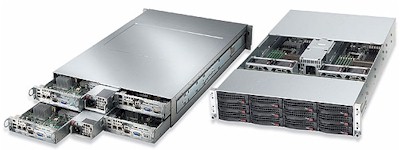
Super Micro's Twin2: Four pounds of chips in a two pound bag
Significantly, the new Twin2 machines will also feature Intel's forthcoming "Nehalem" processors, which are expected to be launched before the end of March.
Super Micro is looking to supercomputing customers as the initial market for the Twin2 machines, and it's telling prospective customers a 2U machine can deliver 353 gigaflops per watt of number-crunching efficiency. Presumably this is peak performance of a machine with eight quad-core x64 processors running the Linpack Fortran benchmark test. Super Micro says that current top-end x64 servers (presumably in a blade form factor) delivered around 300 gigaflops per watt of efficiency, while a regular two-socket, 1U rack server delivers around 250 gigaflops per watt.
This is a big improvement in calculation efficiency with respect to power consumption, and Super Micro is attributing this to the super-efficient power supplies (a new design it has for CPU cooling and air channeling within the server) and updated voltage regulator modules on the motherboards. This is similar to the sales pitch Intel has been giving for its future "Willowbrook" motherboard for its Nehalem processors.
The company says it is sampling the Twin2 servers to test customers now and will begin volume production in early March. You can check out the feeds and speeds on Super Micro's Nehalem boards here. ®
 Biting the hand that feeds IT

