The Register® — Biting the hand that feeds IT

Feeds

NASA talks little green men with Vatican

God, it's me! Xeloclump from planet Zerclumph!

SaaS data loss: The problem you didn’t know you had

It's a good time to be a Catholic and a cosmologist. Heretic stake burnings are at an all-time low, and the Vatican has even warmed to the idea of ETs out there in the infinite expanse.

So, it was a notably un-charred and still-communicated Father George Coyne, former director of the Vatican Observatory, who stopped by NASA's Ames Research Center Thursday night to chat about the possibility of life on other plants.

The verdict's still out of course, pending solid evidence or otherworldly visitation, but Coyne seems extremely open to the possibility. It's a fertile universe after all.

Coyne was joined NASA Ames Center astrobiologist Lynn Rothschild at an evening discussion for the Commonwealth Club and the Yale Club of Silicon Valley. Curiously enough, Coyne spent his time talking about the possibilities of life outside of Earth while Rothschild focused on its limits.

The trick with most space-bound concerns is that the universe is so extremely large and old. About 159,302,326 times as old as Golden Girls' Bea Arthur, in fact. So, to put the entire final frontier into perspective, Coyne preferred to condense the universe's timeline into something a bit more manageable.
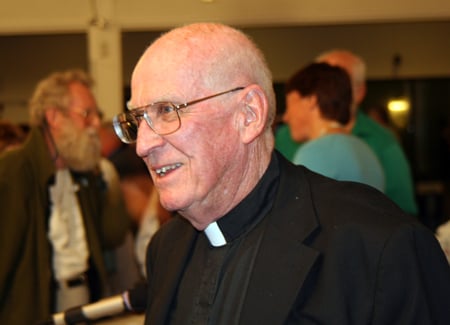
Father George Coyne

Suppose we took our 13.7bn-year-old universe and condensed it to the age of a single year, illustrated Coyne. If the big bang occurs January 1, it's not until September 4 that life on Earth begins. Dinosaurs debut on Christmas day and the first humans don't arrive until 11:58 pm. In that same minute, Jesus is born, said Coyne. One minute later, Galileo observes a heliocentric galaxy and spends his last years under house arrest by orders of the Inquisition.

"The age of the universe is so large in comparison to any history we have, this is what happens when we make it comprehensible to us," said Coyne.

"I've never met a humble or modest astronomer, but we should be," cracks Coyne. "We've been studying a universe that's a year old, and we've been doing it for one second with modern science. So if we don't know everything, give us a bit more time."

But if the Jesuit priest believes extraterrestrials could be out there, where does God fit in? Do little green men read little green Bibles? Will Earth ever get missionaries from the Church of Laser-day Saints?

Going back to his one-year universe model, Coyne again must shrug his shoulders. "All our religious traditions — all I hold dear — God has been speaking to us for two seconds. So, if there's intelligent life, if God did speak to them, I don't have the slightest idea. I haven't absorbed what God has said to us in the last two seconds."

Coyne isn't one to shy away from scientific certainty when there's evidence to go on. Although he left his 30-year post at the Vatican with honors, the American Jesuit priest is believed to have been removed after repeatedly contradicting Pope Benedict XVI's endorsement of the "intelligent design" hypothesis.
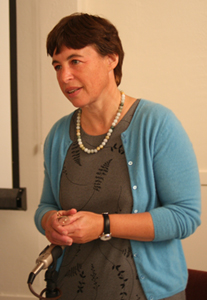
Lynn Rothschild

The question of whether life outside Earth can exist is made more difficult by the fact that we don't know how life here jumped the gap* from inorganic chemicals to Paris Hilton.

Rothschild outlined some of the prerequisites we know about for life as we know it: a healthy amount of carbon, hydrogen, oxygen, as well as a solvent to work the biochemistry like liquid water. Then we need to worry about the proper PH value, salinity, desiccation, chemical extremes, pressure, and radiation.

Then there's time. "We have no idea how long it takes for life to arrive," said Rothschild. "Life by definition is very complex, so we have this feeling that it takes an enormous amount of time -- but it could be simple."

"We do not know yet the jump from the conditions of life and life itself," concurred Coyne. "We don't know the origins for life under our own feet."

Coyne says his faith and science don't need to be contradictory terms. "There is a measure of faith in science," he said. For example, "I trust the age of the universe is 14 billion years when I do my science."

"But the truth is not democratic," Coyne continued. "There's an interplay of being skeptical, but you can't do anything if you're skeptical about everything." ®

Magic Quadrant for Enterprise Backup/Recovery

Latest Comments

Religious people are [clever|stupid]

Athiests do not "know" that god does not exist (unless they are not very logical), they might be pretty sure, confident or just consider it unlikely.

Agnostics are fence-sitters, it's actually takes a significant degree of faith to think that in the absence of any provable, repeatable evidence it's close to 50/50 that god exists, by definition agnostics are people with a lot of faith, around 50% (although, I suspect that most agnostics are in reality Pascal wager atheists - which is odd because if there is a god [he|it|she] knows what you really believe, so there's actually no point in pretending).

Theists believe there is a god, in the absence of any provable, repeatable evidence which means they either right (clever, if they got the right god) or wrong (stupid, if they wasted their life worshiping nothing, or worse making other peoples lives worse because of it).

Exactly the same prinicples follow for belief in aliens;

There might be aliens - but I can't prove it or communicate with them, if they do exist they are probably too far away to reach us so it's not worth living my life like there is aliens.

It's 50/50, I won't commit to belief or otherwise, I'm just as happy to believe in aliens as not to believe in aliens, no point in asking my opinion about them, I have nothing to say (although I might spend a lot of time saying nothing).

Aliens exist, theres no repeatable proof, but lots of hearsay and things I can't personally explain, so it must be aliens, I will make important life decisions on the basis of aliens existing.

So, now for a summary - these beliefs are so close, there really is no "in principle" difference believing in god or believing in aliens, imagine a world where people kill each other because of what different peoples thought their aliens told them, or what about spending two hours every week singing praises to your particular alien - does this make sense?

People have great capacity for caring for their fellow kind, this capacity does not come from aliens|god it comes from humanity, redirect the "love" we feel for aliens|god at people (because that's where you really feel it) and the world will be a better place, if you don't believe me just spend one day (16 waking hours) smiling and being nice to (almost*) everybody you meet and see if you have a better day than whe you do worshipping your alien|god of choice.

*even tramps that smell of wee, unless they acost you

0
0

@ Chris C

On that point, (re: ancient documents) we can be agreed. I always found that point odd about the religions I studied too. Christianity, for example, (my parents were Christian,) states that a man can not know the mind of god. AFAIK, all the bits of the bible were written by men, and what's with this pope thing?

A lot of quirks about a lot of beliefs methinks.

Also don't delve too much into solopsism, the whole

We are all aware that the senses can be deceived, the eyes fooled. But how can we be sure our senses are not being deceived at any particular time, or even all the time? Might I just be a brain in a tank somewhere, tricked all my life into believing in the events of this world by some insane computer? And does my life gain or lose meaning based on my reaction to such solipsism - Project PYRRHO, Specimen 46, Vat 7 (Subject termination advised), Sid Meiers Alpha Centauri

thing is really rather mind/soul destroying if you poinder it too much.

In any case, peace!

0
0

@AC re: Religious people are funny

I apologize if I offended you. That was not my intention. Nor was it my intention to paint/tar all religious people with the same brush, which is precisely why I said "...I find most (not all, as this article points out, but most) religious people extremely funny..." It was my way of pointing out those specific people without having to name them all individually.

As for your assumption, no, I'm not an atheist. The closest definition to what I am would be agnostic. I will never say that God does not exist because I don't know that to be true, nor can it ever be proven. That's the funny thing with negatives -- they can never be proven. Given enough time, effort, and resources, you might be able to prove that something does exist, but you will never be able to prove that it does not exist (if for no other reason, than that it may exist in a way that you don't understand or are unable to measure). For example, with my limited resources, I cannot prove that you exist. You may be someone's AI project. Of course, I cannot prove that I exist, either. I may be a figment of someone's imagination while they are dreaming.

I'm not saying all religions are bad (though, morally-speaking, I do consider any religion which teaches people to hate and kill other people to be bad). And I'm not saying there's no room for science and religion. There are a lot of things we will never know, such as how it all began. The Big Bang theory (as I recall it -- that originally there was nothing, which exploded, thus creating the universe) is scientific heresy since one of our most basic laws of physics is that you cannot create something from nothing. For the same reason, I cannot blindly believe in the existence of God (how did God come into existence?). However, I'm smart enough to know, and strong enough to admit, that the fact that I personally believe in neither is not proof that neither is true.

One thing I do seriously question about all people, but religious people in particular (all religions based on ancient documents), is the complete faith they put into these ancient documents. People literally take these books' words as gospel. Why? Because they're written in a book, even many books? Will human beings one thousand years from now believe that Hamlet or Romeo and Juliet are factually and historically accurate? I'm not saying that specific religions have it wrong, but I think it's a bad idea to blindly believe in anything simply because a book tells you to.

0
0

More from The Register

 breaking news
You've seen the Large Hadron Collider. Now comes the HUGE Hadron Collider
International Linear Collider ready to rock and roll
Headbangers have a gas, gas, gas in mosh pits
Boffins say heavy metal crowds behave like The Vapours
Hubble spies unlikely planet being born in hostile neighborhood
Hoovering a cloud of sand 7.5 billion miles from a tiny star
 breaking news
Jaguar to open new car-making factory in Blighty (virtually)
Britain still makes stuff, it's just not real any more...
 breaking news
China's second woman 'naut blasts off for coupling in HEAVEN
Wang and pals test the cosmic waters for Chinese space station
Scientists investigate 'dark lightning' threat to aircraft passengers
One stormy flight could give lifetime radiation dose
 breaking news
Chinese 'nauts prep for next coupling in Heaven, clear way for new station
Second woman taikonaut and pals test tech for China's own orbiting platform
Boffins hide cute kitty behind invisibility shield
No polarisation or microwaves needed, yet the cat and fish disappear
 breaking news