Fisker shows Karma Sunset in Detroit
Electric car firm's Waterloo?
Cloud storage: Lower cost and increase uptime
'Leccy Tech Fisker used the Detroit Motor Show to unveil the final production version of its Karma electric saloon and tantalise assembled onlookers with the first showing of the convertible Karma S – the S standing for Sunset.
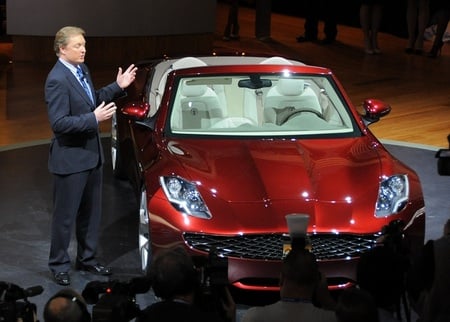
Fisker's Karma S: pretty as a sunset?
OK, it's not a whole lot different from the images we've seen before - a slightly re-worked nose aside - but any excuse for a quick dollop of auto-pr0n before the weekend...
Fisker also announced that it currently has 1000 pre-orders for the Karma and that the first cars will hit the street during Q4.
The Karma is driven by two 150kW electric motors – equivalent to 403bhp - connected to a lithium-ion battery pack, and a 265bhp four-cylinder turbo petrol engine sourced from General Motors.
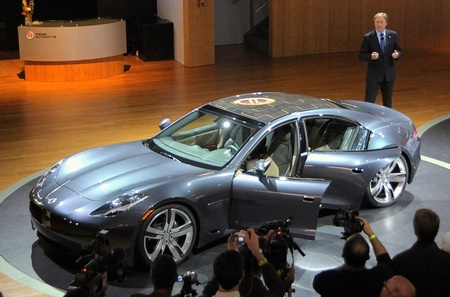
The Karma: goes like the proverbial off a shovel...
In 'leccy only “Stealth Mode”, the Karma can get from standstill to 60 in 5.8s, tops out at 95mph and can run for 50 miles.
In “Sport Mode” – with the petrol engine driving the generator – the Karma will do 125mph and has an effective range of 300 miles.
Phfwoar. ®
Next page: Fisker Karma Photo Gallery
COMMENTS
Wo what we essentially have is ...
a petrol engine with full tank et al charging a battery which will drive the electroc motors which power the car. 3 stage process from petrol to motion, each with losses.
I don't notice any stats on what the range of said beastie will be with a full tank of gas - anyone care to compare that with a similar car that doesn't have all the extra heavy electric gubbins on board?
Paris because there's no intelligence behind this design
No DRender, You’ve missed the point!!!!
This is a luxury abomination touted on their website as a “green” vehicle, which it clearly is not. Any automobile, especially an aerodynamically styled sedan like this one, that requires a total of 403bhp electric power and a 265bph petrol engine isn’t “green”. I don’t care if it can exceed 200mph or reach a paultry 125mph as in this case, IT AIN’T “GREEN”! I don’t even think you read the complete article as your comments certainly don’t reflect it, but let’s take a look at them anyway.
“You can’t remove the electric parts… It IS an electric vehicle.” - I only mentioned removing one of the two electric motors as it is clearly not contributing much power due to a possible mismatch of the battery pack, or some other quirk. However, this appears to be such a poor design that I agree with Andrew Norton and think it would be an improvement to leave out the electric power altogether as based on the listed specifications this company obviously is not showing expertise in this area, at least in my opinion.
“The Petrol engine is decoupled from the drive train completely - it just charges the battery (Or in those rare situations where you need to go faster than 95 - Provide a boost)” - Ummmm…you’re completely wrong here. According to the article the petrol engine drives the generator which provides electricity to the electric motors giving an “effective range of 300 miles” and providing a top speed of 125mph, although I would assume it also charges the batteries in this mode. However, even if you were correct, which you aren’t, then under which universe did you come from that you think it is a good design that requires a 265bhp petrol engine to charge the battery or to “…Provide a boost”. Let’s get real here. A 265bhp engine installed in any automobile, short of maybe a Hummer, will jerk a knot in your ass with plenty of acceleration, yet here they need it to “charge the battery”?
“And seriously, unless you drive a lot on the Autobahns in Germany, want to take it to a track, or just drive like a tw@t, you've no need to go above 95 except in very rare overtaking circumstances.” - Then why are you even looking at this thing in the first place? Go buy a Toyota Prius and save a ton of money. Oh, sorry Andrew, yes the Prius is lacking, but it is certainly many times more “green” than this contraption.
“In reality you could remove the petrol generator and replace it with a diesel one - much more efficient… …You could even completely remove the fossil fuel engine and replace with more batteries, or a hydrogen fuel cell, or ultracapacitors or whatever new technology comes along for the generation / storage of electricity in vehicles.” - Yeah, you could also just look at another vehicle that has proven “green” technologies. At least you’re beginning to get the point that this thing really is crap, at least in my opinion as an engineer. I have to add that it has already been proven that hydrogen fuel cell powered vehicles are just smoke and mirrors since it requires so much energy to extract the hydrogen.
“This is an extremely important step in the move away from fossil fuels. When Fisker start manufacturing more affordable vehicles based upon the quantum drive train I'll be all over them…” - I just about wet my pants when I read that statement! I hope you do buy one of Fisker’s products, as you certainly seem like a good match! However, I’ll agree with you that continued development of electric or hybrid powered vehicles is a move in the right direction, but this instance certainly seems questionable.
DRenar, I’m really not trying to bust your balls but I just want you to look at the numbers to see the truth. Even though this is a very nice looking car, the listed specifications suggest something is amiss and certainly not in line with “green” technology. I would like to know exactly how many miles per gallon this vehicle consumes under its petrol engine since they don't mention that.
Unfortunately, there seems to be an emerging trend that somehow very high powered or high performance electric cars are "green". Green technology, to me, means providing for high efficiency and zero or low fossil fuel comsumption while providing acceptable performance. It is not about just swapping powerplant types, especially if the results are still high energy and/or low efficiency. Keep in mind that the majority of the owners of these vehicles will be using the existing electrical grid to recharge those massive battery packs daily and/or they will be driving under petrol engine power. Either way, fossil fuels are still being depleted at a rapid rate. So where is the "green" in this scenario? Cheers! Jim
@ Andrew Norton & Jim Murphy
You're totally missing the point. You can't remove the electric parts... It IS an electric vehicle.
The Petrol engine is decoupled from the drive train completely - it just charges the battery (Or in those rare situations where you need to go faster than 95 - Provide a boost)
And seriously, unless you drive a lot on the Autobahns in Germany, want to take it to a track, or just drive like a tw@t, you've no need to go above 95 except in very rare overtaking circumstances.
In reality you could remove the petrol generator and replace it with a diesel one - much more efficient.
You could even completely remove the fossil fuel engine and replace with more batteries, or a hydrogen fuel cell, or ultracapacitors or whatever new technology comes along for the generation / storage of electricity in vehicles.
This is an extremely important step in the move away from fossil fuels. When Fisker start manufacturing more affordable vehicles based upon the quantum drive train I'll be all over them - my commute every day is < 25Miles, and as I'll be charging the sucker off a wind turbine in the garden, the only time I'll be using fossil fuels will be 5-10 times a year when I go on a longer journey. Bargain.

Agentless Backup is Not a Myth
Steps to Take Before Choosing a Business Continuity Partner
Requirements Checklist for Choosing a Cloud Backup and Recovery Service Provider
Cloud storage: Lower cost and increase uptime
SaaS data loss: The problem you didn’t know you had