


This article is more than 1 year old
SanDisk flashes notebook flash
Third generation with the secret sauce

SanDisk has unveiled faster notebook flash SSDs using its ExtremeFFS technology and with a new controller, a day after attacking the netbook market.
This is what SanDisk hope will start making inroads into notebook hard drive displacement.
The SATA 7000 family consists of C25-G3 (third generation 2.5-inch form factor) and C18-G3 (third generation 1.8-inch form factor) drives with 60, 120 or 240GB capacities. They use the SATA II (3Gbit/s interface) and are designed as drop-in replacements for existing notebook hard disk drives HDDs).
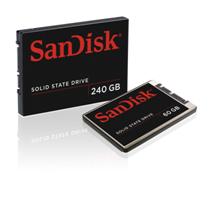
Rich Heye, SAnDisk's SVP and general manager for its SSD business unit, said: "Three key features developed by SanDisk enable this new design: a new SSD algorithm called ExtremeFFS allows random write performance to potentially improve by as much as 100 times over conventional algorithms; reliable 43nm multi-level cell (MLC) all bit-line (ABL) NAND flash; and SanDisk's new SSD controller, which ties together the NAND and the algorithm."
SanDisk doesn't say whether this is 2-bit or 3-bit MLC.
We have been waiting for a mysterious SanDisk third flash ingredient and so, presumably, here it is, the new controller.
SanDisk says these SSDs are more than five times faster than the fastest 7,200rpm HDDs and more than twice as fast as SSDs shipping in 2008, clocking in at 40,000 vRPM1 and having anticipated performance of 200MB/sec (sustained) reads and 140MB/sec (sustained) writes.
vRPM
SanDisk says the vRPM figure for the new drives is 40,000. It calculates vRPM with this formula: vRPM = 50 / ((0.5 / 4kB random read IOPS) + 0.5 / 4kB random write IOPS)). The vRPM figure is a means SanDisk uses to compare SSD and HDD performance.
The previous SATA 5000 notebook SSDs used the SATA 1 (1.5Gbit/s) interface, the slower TrueFFS precursor to Extreme FFS, and performed at 67MB/sec sustained and random reads, 47MB/sec sustained writes and 7MB/sec random writes. They did 5400 random read IOPS with 4kB blocks and 13 random write IOPS at that block size.
We can substitute numbers in the formula above with these values, giving 50 / ((0.5 / 5400) + 0.5 / 13)) for the vRPM rating. That equates to 50 / 0.028554, if my maths is right, and thus to a vRPM value of 1,296.88. On this rating the new drives are considerably faster.
Samsung has announced faster flash, its 256GB SSD having a sequential read speed of 220MB/sec and a sequential write speed of 200MB/sec. It reckons this is equivalent to a 15,000rpm hard drive. No doubt SanDisk has calculated a vRPM value for these Samsung SSDs, but it isn't revealing the result.
SanDisk says its G3 SSDs provide a Longterm Data Endurance (LDE) of 160 terabytes written for the 240GB version, sufficient for over 100 years of typical user usage. SanDisk calculates its LDE measure on the basis of a PC user writing 4GB/day to the SSD.
Sales pitch
SanDisk says users (and corporates) can upgrade existing HDD-based notebooks with these drop-in drives. Heye is quoted thus: "Existing WinXP notebooks can be upgraded to a 60GB SSD for $149, resulting in a system that frequently outperforms a new notebook with a HDD, thereby delaying the need for large capital purchases."
It's an attractive idea, especially with Vista resistance amongst notebook users, but there is that little problem of notebooks having one drive on which the operating system, system applications, end-user applications and data files reside. They have to be copied over to the replacement SSD and then it has to be HW installed and Windows XP installed from scratch plus all of the application software, XP booted and then validated. This is not something the average notebook user may want to do at home and possibly represents an opportunity for PC channel members to offer an upgrade service.
Also Heye says "that frequently outperforms" meaning that, we might suppose, Velociraptor-equipped notebooks won't be improved. We really need greater clarity from SanDisk on candidate notebooks that will have a performance boost from fitting these SSDs. Ideally some kind of performance checking software could be downloaded from the SanDisk website. It would check over your notebook, even your PC, and say whether its performance will be boosted by one of these natty SSDs.
SanDisk has had a third-party, Web-feet Research, do a general check. Alan Niebel, a Web-feet principle, is quoted about it: "Web-Feet Research has tested the replacement of the HDDs in three year old Notebooks with SSDs and has found an improvement in boot times, application loading and general user responsiveness that, in many cases, exceeds what a new notebook with an HDD can deliver." No actual numbers though, so we don't know the amount of the improvement.
The implication of this is that these SSDs won't improve the performance of newer notebook computers, ones less than three years old. Also new notebook prices are coming down and a $499 240GB SSD upgrade cost doesn't look cheap when compared to current low-end notebooks so there is an effective capacity limitation here as well as a restriction to older notebooks. It means that the upgrade is practically restricted to notebooks three years old or more and with hard drive capacity of 60GB or less - pretty crap machines really - whose owners don't want to upgrade to a new entry level notebook running Vista.
This announcement in no way represents a threat to hard drive sales to notebook OEMs in the same way that yesterday's modular flash announcement by SanDisk represented a distinct drive into netbook flash use.
We need another one or two generations of this notebook flash before notebook HDD use is threatened.
OEM prices for the new SSDS are $149 (60GB), $249 (120GB) and $499 (240GB) and they will be available, in a 2.5-inch PATA configuration, in the middle of the year for DIY HDD replacement through purchase off the SanDisk website. SanDisk hasn't revealed any other availability information. ®
 Biting the hand that feeds IT

