


This article is more than 1 year old
Reg readers say ‘don’t panic’ about the economy
Another choice cut from the Reg barometer survey

Reg Tech Panel Few would now dispute the reality of the global ‘credit crunch’ and the economic downturn this has triggered, which has already hit in most major economies, and according to many pundits is set to continue through 2009 and beyond. But what do Reg Readers make of it all?
This is a question we investigated during our recent ‘barometer’ survey, and feedback we received suggested that while only a minority of IT departments have felt the squeeze so far, most are either expecting an impact or are well aware of the possibility of IT investment being hit.
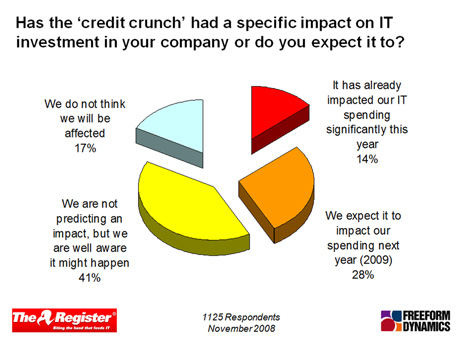
Furthermore, views are remarkably consistent across major geographies and size tiers.
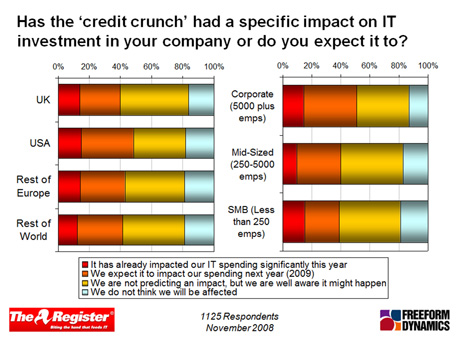
Figures like this confirm the global nature of the challenge, but also highlight that impact is anticipated at all levels within the business community, from the small to medium businesses (SMBs) to the largest multi-national corporations.
We do, however, see some significant variation by industry, with the highly challenged Financial Services sector, not surprisingly, being top of the list of those already hit by the crunch.
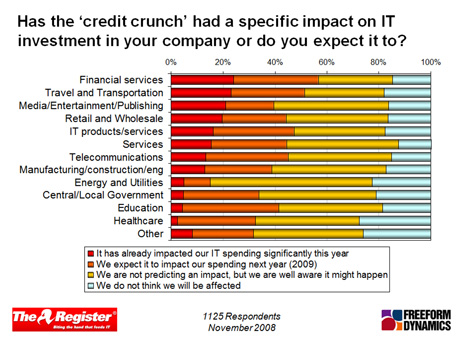
It is also not surprising to see Travel and Transportation appearing second on the list. Organisations in this sector are clearly already suffering as a result of business customers cutting back on an obvious area of discretionary spend, and many consumers now thinking twice before booking holidays and other leisure travel. The prominent position of other industries reliant on consumer confidence, such as Retail and Media, is similarly understandable. It is then interesting to see IT Products and Services companies in the top half of the table, which corroborates the emerging financial pressure on IT in general.
Perhaps most striking about these figures, however, is the fact that around four out of five organisations in every sector acknowledge the possible impact, suggesting that the variations we are seeing right now are mostly a result of where industries are in the row of dominos as the original credit crunch that started in Financial Services has knock on effects that roll across the economy as a whole. To put it another way, it is less of case of whether organisations are going to be hit, and more one of when the hit will come.
But how great will the hit be when it does arrive? What’s interesting when we consider this question is that the majority of those who are expecting challenges are anticipating being able to contain the impact on IT through selected cut backs and/or some general belt-tightening.
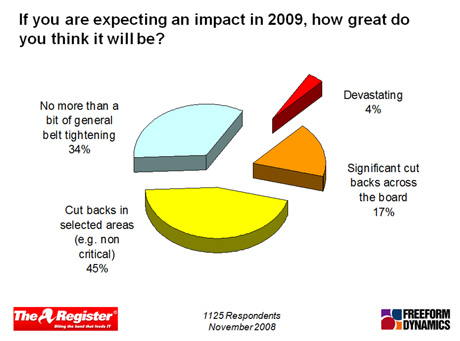
Consistent with this is anecdotal feedback from IT leaders and vendors we at Freeform Dynamics interact with on an ongoing, in-depth basis. We are hearing from both camps that there is an interesting contrast between the situation today and the last big market crash that took place in 2001.
Back then, IT investment had gathered momentum after over a decade of aggressive activity around client/server, ERP, CRM and ultimately Web based technologies and the dot com frenzy, during which many IT departments were given a lot of autonomy from a spending perspective. When the crash came, it was therefore akin to a speeding car being driven into a brick wall, with all the associated damage, disruption and heartache.
The difference this time around is two-fold. Firstly, as IT departments began to recover from the previous crash, generally around the 2005/6 timeframe, investment was ramped up gradually and was kept very much in line with business priorities in most organisations. Indeed, the phrase ‘IT governance’ has become very prominent and pertinent over the last three years as the foundation for approaching IT investment in a much more considered and objective manner. To continue with our analogy, while the car is back on the road, it is now being driven safely within the speed limit.
The other difference is that, with the possible exception of those in the Financial Services sector, IT departments have had a lot more warning this time, so are able to think through how to handle the impact of the economic downturn proactively rather than reactively. The sentiment we are picking up is therefore akin to the car currently being driven on a straight road, in the knowledge that there are rough surfaces and inconvenient obstacles ahead that are likely to slow progress but can be navigated successfully with care.
Of course whether IT professionals are being over optimistic and the road ahead turns out to be rockier than anticipated remains to be seen. Either way, with the luxury of at least a little time to think and plan, it is wise to consider options and prepare and act accordingly in order to maintain control.
One way in which IT departments can increase their chances of maintaining control, is to think beyond their immediate domain. While exploring ways of reducing internal IT costs is important, the big differences can be made helping the business optimise the way it uses IT, introducing new IT capability that enables the business itself to become more efficient, and thinking about how IT can assist the business in driving the top line.
These ideas, along with a discussion of potential role of alternative sourcing, delivery and funding models, are explored more fully in the Freeform Dynamics report entitled IT Delivery in the Downturn, which can be downloaded free of charge here.
 Biting the hand that feeds IT

