


This article is more than 1 year old
American IT staffing will not tank in Q1
Outlook only semi-dour

There is a lot of bad economic news out there, and sometimes, it is easy to wallow in despair. But there is some good news if you are on the IT staff here in the United States. According to Robert Half Technology's latest survey, which asks CIOs and IT managers about their staffing plans for the first quarter of 2009, the vast majority of companies are planning to keep the staff they have, with only a slightly larger number of shops saying they would be making layoffs compared to a year ago.
RHT is an IT headhunter and employment analysis firm based in Menlo Park, California and has been compiling a quarterly IT hiring index since 1995. And in its latest survey, which is based on more than 1,400 telephone interviews with CIOs from companies across the U.S. with more than 100 employees, 82 per cent of those polled said they had no plans to change their IT staff in the first quarter of 2009; 12 per cent said that they would be increasing their staff, and only 4 per cent said they would be making decreases. (Some 2 per cent of shops said they didn't know what they were going to do).
The situation is not perfectly rosy, of course, because throughout 2008, slightly more CIOs than usual are saying they will be making cuts and slightly fewer said they would be adding staff. Check out the trends for the past two years:
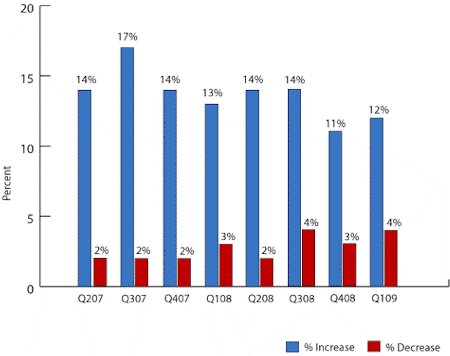
IT staffing adds vs. cuts
The point is: The numbers are not as bad as many might expect for the IT area. The bigger the company, the more likely a company is to be making IT hires, says Katherine Spencer Lee, executive director at RHT. About 14 per cent of the CIOs at companies with 1,000 or more employees will be adding IT staff and only 3 per cent are making cuts - that's more additions and fewer layoffs than the national average in the poll.
"Businesses remain cautious in their hiring outlook, recruiting IT staff who can help them maximize the use of technology to improve efficiency, achieve cost savings, and gain a competitive edge," said Lee in a statement accompanying the numbers. "Investments in Web 2.0 initiatives continue to generate demand in areas such as Web development and help desk."
When asked what the main reason was for hiring IT staff, 32 per cent said it was being compelled the growth of the business, and 21 per cent cited a need for more end user and customer support staff. System upgrades were cited by 17 per cent of the CIOs as the main reason for hiring, and 11 per cent said it was required as part of an ERP installation. Security projects were cited as the driver for projected IT hiring in the first quarter of 2009 by 12 per cent of the CIOs polled.
Ironically, 7 per cent said they didn't know why. In another irony, CIOs in the construction industry - which has been a big component of the 1.87 million job losses so far in 2008 in America - were going to be the most aggressive about hiring and the least aggressive about firing in their IT shops in the first quarter of 2009. The wholesale industry looked almost as good, as did financial services and real estate sectors. Here's the industry breakdown of expected increase and decreases:
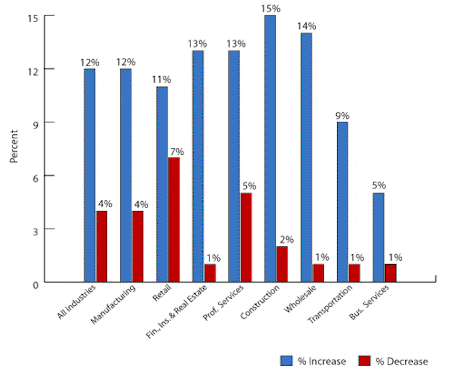
IT staffing prediction by industy
Network administrators were cited by 70 per cent of the CIOs as the kind of technical skills they needed to add most. (They meant both local and wide area network admins.) Windows server administrator and desktop support were both cited by 69 per cent of the CIOs as being in demand. Database administrators were in demand at 59 per cent of the companies surveyed, followed by wireless network admins at 53 per cent of companies, telecom support at 48 per cent, and Web development and Website design at 42 per cent.
Virtualization, business intelligence, Linux or Unix administration, and .NET and Java application development were cited by fewer companies as driving hiring in the first quarter. This is not necessarily an indication of importance, but rather of more balance between demand and supply for particular skills in the IT department. ®
Copyright © 1996-2008 Guild Companies, Inc. All Rights Reserved.
 Biting the hand that feeds IT

