The Register® — Biting the hand that feeds IT

Feeds

Toshiba launches Cell-derived HD TV

No Cell inside, though

Thanks to some careful wording, Toshiba’s been able to launch the "world’s first upscaling TV".
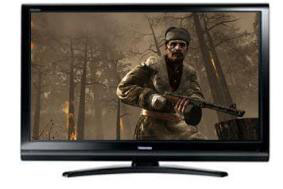
Toshiba_Regza_ZV_01

Toshiba's Regza ZV: with Resolution Plus

Don’t be fooled by its use of the English language though, because the Regza ZV 1920 x 1080p screen’s actually the world’s first upscaling telly... to feature Toshiba’s Resolution Plus technology, which improves images by “increasing image definition and improving picture edges”.

This is achieved by inclusion of the firm’s Quad Core HD processor - aka the SpursEngine - which is based on bits out of the Cell processor, but – crucially – isn't the Cell processor itself.

The ZV’s SpursEngine reviews adjacent areas of an image to determine “waveforms of a similar nature”, before combining pixel information to enhance edge detail and improve the perceived depth and texture of the final picture. In short, you’ll just see a sharper and more defined image, apparently.

Regza ZV fans will be able to choose between a 42in or 46in screen and be confident that there are only minuscule differences between them, apart from their screen sizes.
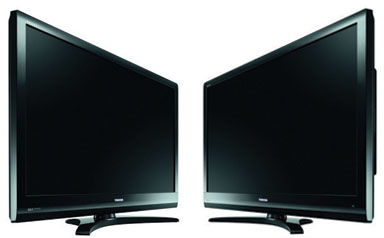
Toshiba_Regza_ZV_02

HD (almost) images from SD content

For example, the 46in model betters the 42in model’s 17,000:1 contrast ratio with a 30,000:1 value. The larger model’s response time is also three milliseconds longer than the 42in model’s 5ms response time, which isn’t good if you’re in a hurry for a Hollyoaks fix.

Both sets feature 100Hz frame rates – although Sony's already up to 200Hz - and have a built-in digital tuner. Three HDMI ports are integrated as standard and you’ll be able to mount either size screen to your wall.

Toshiba’s Regza ZV TV will be available at the beginning of December, with the 42in model priced at £900 ($1415/€1100) and the 46in screen at £1200 ($1885/€1465).

Latest Comments

It's digital dude - the "original picture" was lost long before it reached you!

"For example, I imagine the producer, director, editor, etc of a motion picture just might think that their original picture is better."

Indeed they would. And it's for this reason that the TV does it's best to recreate that original picture. The picture source is NOT the image that the producer/director/editor created. Even broadcast TV images are not received at production quality - the pixel resolution may be the same (with digital transmission), but the content of those pixels has been squeezed and colour mapped to fit into the available space in the airwaves.

The same applies, to a lesser extent obviously, to DVD and even HD/BD content.

Even movies created for digital projection are of higher resolution than Full HD.

You could watch the content as unprocessed as possible (beyond raw MPEG decompression). Or you choose the best video processor in your input chain to extract as much picture INFORMATION from the picture DATA as possible. That might be your DVD player, it might be a dedicated video processor or it might be the circuitry in your TV (or projector etc).

So now Toshiba have (or claim to have) improved the ability of the TV itself to do this, so you should get the best display for all your source material, but if you already have acceptable or preferred video processing applied to some of those sources, presumably you can tune the additional TV processing, or even turn it off.

0
0

Cellish

Well, the SPURSengine happens to have a few of the Cell's important fast bits (the SPEs), so all is well. That Toshiba changes the PPC core for something other surely means it would be overkill for a rather fixed function processor.

(I don't think it is just an unsharp mask op: it probably derives info from several frames at once and some other voodoo)

0
0

Stuff to list on the box...

Can it do anything useful like de-interlace difficult material?

When sales types talk about stuff like increasing image definition, improving colour and edge enhancement my usual question is "can you turn that off?" This can be a lot of fun at trade shows if a few others catch on and several people ask "can you turn that off" after they talk about each useless feature.

0
0

@Chris C

Since they're saying 'upscaling', I'm presuming the point is to take 480p or 480i content and do a better job getting it to 1080p than usual (with usual being anywhere from nearest-neighbor to bilinear in terms of quality). My guess is they're doing something like I do with ffdshow for DVD upscaling - a 5-tap deinterlace, lanczos upscaling, and some kind of high quality sharpener, not just an unsharp mask. I'm using a neat sharpener called LimitedSharpenFaster (with the point being its ability to heavily sharpen upscaled content *without* ringing or other artifacts) on my home theater machine, but it's massively CPU intensive and I'm not sure mainstream companies are using something like it for sharpening yet.

Regardless - processing a 1080p image isn't going to do any good, you're right. But you can do a WORLD of good to an SD signal - getting it maybe 70% of the way to HD from 30% - with the right process.

All that said, TV manufacturers have a penchant for applying ludicrous levels of saturation exaggeration while simultaneously crushing blacks and whites and then tossing on rabid amounts of contrast, and calling the whole thing something like "Super X-phase 2 modulation signal enhancement with XRT2 Tri-Tritone Phase technology", instead of the more accurate, "Rape Your Image" - and so I don't necessarily trust that they're doing anything good with this, even though they could well be.

0
0

re: Improving?

Chris C: "Am I the only one who thinks a television should simply display the data it receives without trying to guess what the picture represents..."

So you want a tiny 704×576 pixel image displayed in the middle of your big 1080p HDTV?

Weird.

0
0

More from The Register

 breaking news
US boffin builds 32-way Raspberry Pi cluster
Beowulf cluster built for the price of a single PC
Nintendo throws flaming legal barrel at YouTubing fans
All your walk-through vid revenue are belong to us
Fairphone goes on sale to all
The Android handset that's PC can be yours
Microsoft reveals Xbox One, the console that can read your heartbeat
Upgrades Live service – and no always-on requirement
HTC woes prompts 'leave now' tweet from former staffer
Chief product officer latest to bail from sinking mobe-maker

Hands on with Hyper-V 3.0 and virtual machine movement

Our award-winning Regcasts have teamed up with training provider QA for the deepest of deep dives into Hyper-V, including a live demo.

Understand VM movement - just click to play, or go here for a bigger version.