


This article is more than 1 year old
Ancient galaxies pose for the camera
Fetching ultraviolet snap of deep, deep space

The European Organisation for Astronomical Research in the Southern Hemisphere (aka ESO, or European Southern Observatory) has released a rather fetching snap of distant galaxies posing in the U-band - the boundary between visible light and ultraviolet - which shows some clusters of stars so old that they're seen "as they were when the universe was only two billion years old".
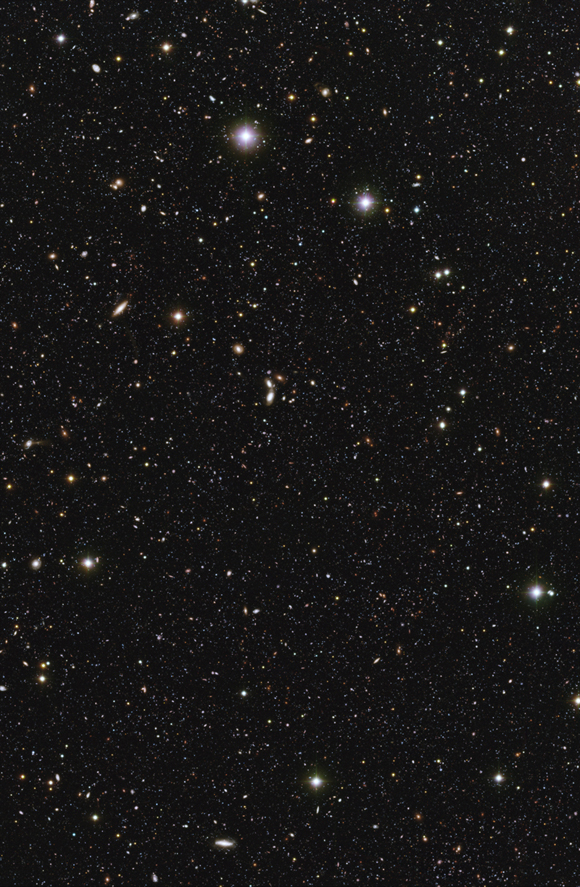
ESO explains that the image of the Chandra Deep Field South is "the deepest ground-based U-band image of the universe ever obtained", comprising 27 million pixels grabbed in part by the Very Large Telescope (VLT) and "the VIMOS [Visible Infra-Red Multi-Object Spectrograph] instrument in the U- and R-bands, as well as data obtained in the B-band with the Wide-Field Imager (WFI) attached to the 2.2 m MPG/ESO telescope at La Silla".
The photo forms part of the Great Observatories Origins Deep Survey (GOODS), designed to "provide astronomers with the most sensitive census of the distant Universe to assist in their study of the formation and evolution of galaxies". In this case, ESO detected galaxies which are "a billion times fainter than the unaided eye can see and over a range of colours not directly observable by the eye".
ESO elaborates: "Observations in the U-band, that is, at the boundary between visible light and ultraviolet are challenging: the Earth's atmosphere becomes more and more opaque out towards the ultraviolet, a useful property that protects people's skin, but limiting to ground-based telescopes.
"At shorter wavelengths, observations can only be done from space, using, for example, the Hubble Space Telescope. On the ground, only the very best sites, such as ESO's Paranal Observatory in the Atacama Desert, can perform useful observations in the U-band. Even with the best atmospheric conditions, instruments are at their limit at these wavelengths: the glass of normal lenses transmits less UV light, and detectors are less sensitive, so only instruments designed for UV observations, such as VIMOS on ESO's Very Large Telescope, can get enough light." ®
Bootnote
We're delighted to note that the ESO's press officer is called Dr Henri Boffin. Good show.
 Biting the hand that feeds IT

