The Register® — Biting the hand that feeds IT

Feeds
80%

Olympus E-420 digital SLR

It’s dinky and it delivers good pictures

Review Many of us want the slimmest, lightest, most portable camera we can afford. No surprise, then, that Olympus is making a lot of noise about the E-420, claimed to be the “world’s most compact DSLR”.

The E-420 is certainly a tiddler when compared with most other DSLRs on the market, measuring 129.5 x 91 x 53mm and weighing just 380g without the battery. That said, the E-420 is hardly in the same league as a compact camera, especially when you slap a zoom lens on the front - although Olympus does offer a 25mm/f2.8 fixed-focus pancake lens, just 24mm deep.
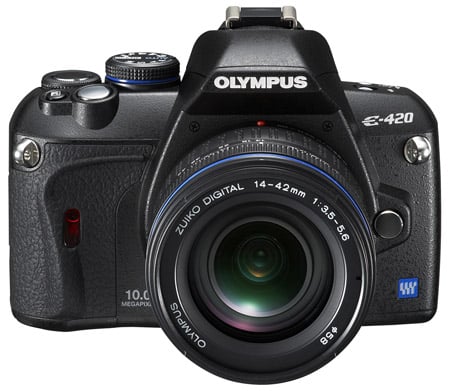
Olympus E-420 DSLR

Olympus' E-420: dinky compared to other DSLRs

We used the E-420 with a 14-45mm/f3.5-5.6 lens and that combination would certainly be a tight squeeze in your average handbag. The camera uses the "Four-Thirds" lens interchange system specially developed by Olympus and Kodak for digital photography and supported by others, including Panasonic and Leica, although many other big names, such as Canon and Nikon, do not.

The E-420 has a ten-megapixel 4/3in Live MOS sensor, which measures 17.3 x 13mm. A quick tour of the camera reveals at the top, a flash button - incidentally, the E-420 has wireless flash capability; a multi-function button for remote control, timer and sequential shooting; pop-up flash; hot shoe; and, on the right, a large mode dial (with power on/off lever below), control dial, shutter button and exposure compensation button.
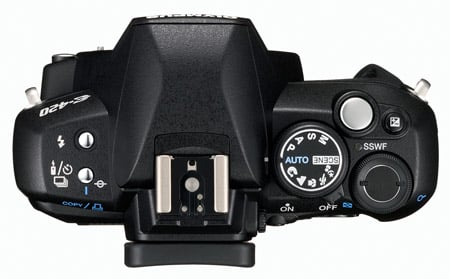
Olympus E-420 DSLR

The E-420 has wireless flash capability

The back of the camera is dominated by a 2.7in LCD, to the side of which are a playback, delete, Menu and Info buttons. To the right, you’ll find AE and AF lock button, display mode button and rocker control dial (including a function button) with a central OK button.

Latest Comments

@Eden

I'm not making any points about printing paper, I'm suggesting that image ratios don't amount to much if they get cropped anyway or if you're printing you select 'image to fit paper size' in whatever software you happen to use. Oh and not all pictures submitted to news desks are by professionals, there are citizen journalists who photographed the July bombings with simple camera phones remember?

Ratios, image quality all take second place to context and composition.

I also know and I saw (along with my 500 million friends :)) some Olympus cameras at the Olympics from Professional photographers (citing one example). The E3 is one hell of a professional camera. Everything isn't Canon and Nikon you know. If you go higher up into digital medium format territory, you'll find 6x4.5 and 6x6 sensors being used which don't conform to your hallowed 3:2 aspect ratio.

Just accept that Olympus is doing fine without you or your 500 million friends with their 4:3 ratio okay? I can't say I care too much about ratios since I shoot using both of them along with 6x6.

0
0

4:3 is dead

CrackedButter, yes, me and 500 million of my nearest friends.

The overwhelming majority of photos are printed on 6"x4" paper = 3:2

If you have a 3:2 camera you do not need to use Photoshop or Irfanview to adjust every shot - they just fit. The scary part is that most people who put their photos in for printing do not even realise that there has been a slice automatically removed from the top and bottom to make them fit.

Professional photographers who submit photos to newspapers etc will use a professional grade camera, not a 4/3s Olympus.

The market will decide the winner, I would not buy shares in 4:3 DSLRs.

0
0

@Eden

Well done on not addressing my point about the other media types out there besides the blessed LCD monitor. Btw, your last post illustrates that 4/3rds isn't for YOU as you've admitted you don't print anything.

0
0

4:3 is dead

Charles, we are getting off the point here, and I think our definitions of "traditional" vary. I had two film SLRs prior to going digital and they were both Pentax and 3:2. Most modern glossy paper and picture frames are 3:2.

The point of my original post is that the 4/3s consortium are flogging a dead horse. My photos are displayed electronically, I have not printed in years. TVs are widescreen, computers are widescreen and 3:2 is close to widescreen with only small black bands on each edge, whereas 4:3 displayed on a 16:9 TV only uses 83% of the available screen area. I use a Pentax K200D and am very pleased Pentax choose to stick with the 3:2 format.

0
0

@ Greg Eden

Sorry, but you're wrong.

The Traditional photopaper sizes (5x4, 10x8, 16x12, etc) have always been based around the ratio of the 5x4in (quarterplate) format, it wasn't until Oskar Barnack decided to stick 35mm movie film, sideways, in his new Leica camera that the 3:2 format was born. It is that which has been continued in current DSLRs.

0
0

More from The Register

New Lumia 925: This, loyalists, is the BIG ONE you've waited for
Nokia veep drills high-end master plan for El Reg
Review: HP Pavilion 14 Chromebook
All roads lead to Chrome?
Borked your iDevice? Pay EVEN MORE to have it fixed by Applecare
Or scream at their hapless techies on their forums
Euro PC shipments plummet into bottomless pit of DOOOOM
11th quarter of decline, 20pc drop on last year - Gartner
Report: AT&T dropping Facebook phone after dismal sales
Turns out folks won't buy that for a dollar
Nintendo throws flaming legal barrel at YouTubing fans
All your walk-through vid revenue are belong to us
Which petite model likes a fondle and GETTING WET? Sony's Xperia ZR
Take this new mobe swimming. Just not deep, or for long, OK?