The Register® — Biting the hand that feeds IT

Feeds

Slimmer and lighter cameras promised

DSLR snappers benefit from enhanced lens technology

Significantly lighter and more compact DSLR cameras and lenses are on the way from Olympus and Matsushita, thanks to the development of new lens technology.
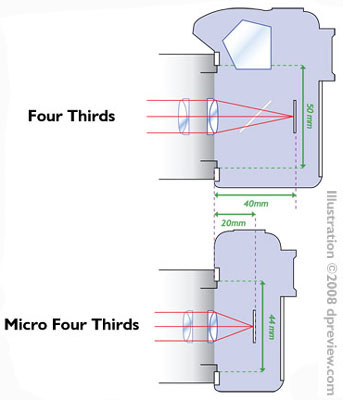
MFTS_drawing_02

The MFTS promises smaller and lighter cameras

The two firms have pledged to work together to produce lighter and more compact interchangeable lens type digital camera systems based on the Micro Four Thirds System (MFTS) standard, which builds on the existing Four Thirds System (FTS) standard developed by Olympus and Kodak.

The MFTS uses the same 18 x 13.5mm sensor size as the FTS does, but enables slimmer cameras by removing the need for an optical viewfinder and mirror box.

Removing the mirror box allows for a 50 per cent shorter flange-back distance, but removal of the optical viewfinder means users are forced to frame images using the camera’s LCD display.

More compact lenses are also expected to be developed, particularly in the wide-angle and high-power zoom range.

It’s worth noting that existing FTS lenses can be used on snappers based on the new MFTS technology, thanks to a specialist adaptor.

Neither firm has announced when they’ll release cameras or lenses based on the MFTS standard.

Latest Comments

Horses ... courses ... hmmm

I used to shoot with a Finepix S5000 - the digital viewfinder was great in that I saw 100% of the frame I was getting, against the 95% of the frame I'm seeing on the K20d's optical viewfinder ... but there are situations where the Finepix just couldn't get enough light to see what I was shooting in darker conditions, whereas with the optical, my eyes would adjust to the low light level.

The ability to frame consistently does away with a bit of the post production work, editing out what ended up on the edge of an image but you couldn't see it ... but the optics certainly perform in areas where the sensors "live view" don't/can't.

As for the sensor size, everyone just got hung up on it and the manufacturers responded. Even Pentax, with their quite impressive APSC nearly fifteen megapixel sensor have bowed to the "trend" and are working on a full frame. What is possible with sensors is improving so that size doesn't really count any more and cross talk is being eliminated ... Fuji's newer HDR sensors pack twice the sensors in the same area (two sensors for every image pixel to achieve the HDR image) so ... size doesn't matter ... or, I don't care any more as to what bloke tells me that this <------> is six inches.

0
0

Re: crapaculous EVF

My goodness, I do I believe we may have hit on a problem. Or perhaps the manufacturers have thought of this already, and are innovating with a new generation EVF: higher resolution and more responsive. Been done before, no reason why it couldn't be done again. Unfortunately, because typical sensors and LCDs do not have equivalent dot layouts, there is inevitably a bit of real-time processing that has to be done to get from one to the other, but nothing a bit of extra grunt can't obviate. Bear in mind that semi-pro and better cameras (i.e. primarily DLSRs) have traditionally had more grunt than consumer compacts anyway (witness writing speeds etc), so we really don't know what kind of EVF performance they could already be capable of if effort was put into making it usable, as it surely will be.

I say give them a chance; it won't be to everyone's tastes, but I agree with the dpreview analysis that this is "without doubt the most exciting digital photography announcement this year".

0
0

crapaculous EVF

<i> martyn • Wednesday 6th August 2008 10:54 GMT

The sensor lets you see straight through the lens (which you couldn't with a film camera) so why keep an expensive complicated and unnecessary piece of machinery? </i>

errr.... do you even know what a SLR is to have posted that comment? indeed that is the single biggest advantage of an SLR is that you DO look straight down the capture lens.

so we replace the mostly excellent pentamirror/pentaprism and reflex mirror with a totally craptacular electronic viewfinder...

don't get me wrong live view on the new DSLR's is a far far better feature than I had it pegged to be, really useful for macro focussing and for landscape composition... but you'd never want to actually shoot anything that's not static (ie 95% of real world shooting) with that nor would you with an EVF

0
0

@martyn

>> The sensor lets you see straight through the lens (which you couldn't

>> with a film camera) so why keep an expensive complicated and

>> unnecessary piece of machinery?

I don't own an SLR, I own a bridge-camera. I can tell you that its EVF is its weakest feature (although the fold-out 2" display is probably its best). Why? Because a good EVF will have a resolution of about 0.2 MP and refresh at 60 Hz - where as the resolution and refresh rate on an optical view finder will probably outperform the human eye.

Another point is that most CMOS sensors used on dSLR cameras are not suitable for constant exposure, so it would require a different type of sensor. Chance are it wouldn't perform as well as a regular sensor.

0
0

@ martyn, stu

You may be taking a digital representation of what you see, but in no way other than basic composition does what you see on your LCD represent the final image.

I'm not saying there aren't advantages to LCD viewfinding, as anyone who's ever put their joints out wrapping themselves round a tripod trying to get to that tiny aperture at the back of their camera for a tricky macro shot will testify. But there are gizmos out there already to help with that.

Until LCD can match the response time, colour gamut and resolution of at the very least the camera's own sensor, never mind what I can see with my own eyes through the lens, I'll be sticking with my nice lo-tech, hi-quality viewfinder thank you very much.

0
0

More from The Register

 breaking news
Apple cored: Samsung sells 10 million Galaxy S4 in a month
Beware of South Koreans bearing Android
Microsoft reveals Xbox One, the console that can read your heartbeat
Upgrades Live service – and no always-on requirement
US boffin builds 32-way Raspberry Pi cluster
Beowulf cluster built for the price of a single PC
Review: HP Pavilion 14 Chromebook
All roads lead to Chrome?
Euro PC shipments plummet into bottomless pit of DOOOOM
11th quarter of decline, 20pc drop on last year - Gartner
Fairphone goes on sale to all
The Android handset that's PC can be yours
Nintendo throws flaming legal barrel at YouTubing fans
All your walk-through vid revenue are belong to us

Hands on with Hyper-V 3.0 and virtual machine movement

Our award-winning Regcasts have teamed up with training provider QA for the deepest of deep dives into Hyper-V, including a live demo.

Understand VM movement - just click to play, or go here for a bigger version.