Pentax K20D digital SLR
A serious DSLR for the serious snapper
Review The arrival of the Pentax K20D on our doorstep last week marked the end of an era - that of the venerable, battle-scarred Pentax LXs and MXs, which have over the last 20 years or so provided faithful service.
The world has moved on, though, and once the switch had been made to digital, the K20D offered one crucial incentive: it could accommodate a stack of old Pentax lenses without fuss, according to the manufacturer. More on that later.
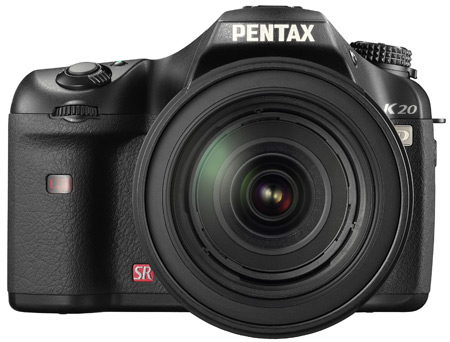
Pentax's K20D: posing for the camera
Unboxing the K20D reveals a 141.5 x 101 x 70mm body weighing in at 715g without the battery. The bundle includes a strap, Li-ion battery and charger, viewfinder cover, AV and USB cables, plus Pentax's Photo Browser, Photo Laboratory and Remote Assistant CDs plus, of course, an ominously thick instruction manual.
The ergonomics of the "fibreglass reinforced polycarbonate body with high-grade steel chassis" are pleasing enough, with the expected rubberised hand grips giving no cause for complaint. The K20D apparently boasts "72 seals on the camera body and 38 seals on the battery grip combine to ensure that humidity, dust and sand cannot adversely affect the camera", although there doesn't appear to be a seal to protect the top-mounted pop-up flash.
The heart of the beast is a 23.4 x 15.6mm CMOS offering around 14.6 megapixels, which you can exploit for either 14.6Mp (4672 x 3120), 10Mp (3872 x 2592), 6Mp (3008 x 2000) or 2Mp (1824 x 1216) JPEGs, or 14.6Mp (4688 x 3120) RAW in either compressed PEF or non-compressed DNG flavours.
The practical upshot of this is, on a 2GB SD card, you're going to get around 82 RAW snaps, 138 14.6Mp JPEGs, 206 of the same at 10Mp, 359 at 6Mp and 931 at 2Mp. Those JPEG figures are for the Premium compression ratio of 1:2.8. All JPEG sizes offer this and Best (1:4.5), Better (1:8) and Good (1:16).
COMMENTS
Noise?
I did not see the word "noise" anywhere in the review. Sensor noise is one of the most important characteristics of a camera, and is a big determinant of the image quality.
And then there is dynamic range, and possible clipping of highlights. That wasn't mentioned either.
This comment is not meant as a put-down of this camera. It's just that after getting my fingers burned on a noisy range-limited Olympus E-510, I want to hear all about sensor noise and dynamic range on any camera reviewed. That is much more important than how many knobs the camera has.
Oh, and one more thing: Are the metal brackets of the hot-shoe connected to the internal metal frame of the camera? If not, then just mounting an external flash unit on the camera, and doing some walking-around city-street shooting with the camera occasionally banging against your chest will pull the hotshoe brackets out of the plastic case, and now you have a broken hotshoe, like happened with my E-510. I expect more from a thousand-dollar camera.
Shooting RAW
"making shooting RAW an option rather than a necessity"
That's good to know, although I'd like to do some comparisons myself, to see if it improved from the K10D. (sore excuse to get a new one?) :-)
I did shoot the same scene (with my K10D) using the RAW+Jpeg option (great stuff). The thing is that the sharpness of the Jpeg version, when looking at 100%, is quite lower than that for the unprocessed RAW -- that's due to the "aggressive" in-camera noise reduction algorithm. So when I have important shot, I prefer to decide myself later how much sharpness I can afford to lose when doing noise reduction manually (if at all needed, to begin with).
If the NR algorithm got better for the K20D, that would be very nice...
Lenses / K10 vs K20
I've upgraded right from the Pentax istD digital to the K20D and it's been quite a jolt. I've been reading the K10D manual and the K20D will give you higher resolution and more options for in-camera processing. There's an extensive selection of "tweaks" for creating jpegs: Landscape, Portrait, Vivid, Normal, and Black and White and each of these settings have further adjustments making shooting RAW an option rather than a necessity. It also allows shooting both RAW and jpeg with a touch of a button so you can make that decision later.
One of the sweetest features is the built-in Vibration Reduction which reads the focal length of the lens and allows more clear hand-held photographs. Unlike other cameras, now every lens in your collection is a VR lens.
The worst thing Pentax has done has been to eliminate all film cameras. These were the same people who introduced us to the K-1000. They are now focusing entirely on digital. The K20D is a great contender for Nikon's flagship camera. It's 20% smaller, 50% lighter, and 1/5 the price while producing higher resolution. Rather than the old CCD technology, the K20D switched to CMOS technology to reduce noise. It even has a dead pixel mapping feature and dust detection and elimination built right into the camera to reduce trips to the repair shop.
Shortage of lenses?
I also have 16mm f2.8 to 300mm f2.8 covered in prime lenses. Infact a number of them are at focal lengths that aren't available from other manufacturers.
Also keep in mind that Pentax has a long history of backwards lens compatibility and there are over 200 different Pentax lenses, (plus third part offerings), that are useable on the Pentax K20D. Furthermore they all work with focus confirmation and image stabilization.
I want one - NOW !!
Have a lot of Pentax glass, starting back in the 70's with my MX. Currently using the K100D Super...
The K20D is superb! I just want one - saving now!
