The Register® — Biting the hand that feeds IT

Feeds

Northrop: battlefield rayguns to demo this year

Laser-cannon 'building block' test success

What you need to know about cloud backup

US weaponry goliath Northrop Grumman says it has achieved the "first major building block" necessary for manufacture of a 100 kilowatt solid-state laser - that is, a viable battlefield raygun.

The company said yesterday that its Joint High-Powered Solid State Laser (JHPSSL) programme has "exceeded all target requirements of its second major demonstration milestone". This was the trial of a "laser chain" with 15 kilowatt power. Northrop intends to combine eight such units to produce a single laser beam of more than 100 kilowatts - which is generally considered the level at which energy beams would become useful combat weapons.
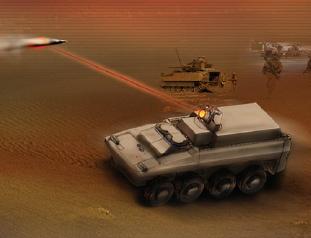
Northrop's laser-panzer concept

The laser tank: probably unable to fire on the move.

"Our team has developed a compact modular laser with excellent beam quality, which can be used alone or coherently combined with additional laser chains to reach 100kW and beyond," said Northrop raygun exec Jay Marmo.

His colleague Dan Wildt added: "With the successful demonstration of a complete laser chain - the building block of the fully integrated solid state laser - the hardest part is over."

Electrically powered solid state lasers are not currently able to develop combat-worthy power levels, and the main US raygun programmes which might see service soon - the ICBM-nobbling Airborne Laser (ABL) and the shorter-range, less powerful Advanced Tactical Laser (ATL) - use chemical beam-generation technology instead.

However, the requirement to carry large amounts of dangerous chemical fuel - and to contain the resulting toxic hazmat exhaust products afterwards - means such weapons are cumbersome and logistically marginal. They are only deployable aboard large cargo aircraft, if at all.

Solid-state laser technology is seen as potentially better, as it could be practically fielded aboard tactical jets or ground vehicles. The idea, at least initially, would be to use lasers to explode incoming enemy missiles or shells in flight.

Northrop is bullish about its JHPSSL technology, saying it will link up its building blocks into a combat-power death ray by the end of the year. The programme is "on track for a full power system demonstration of 100kW by the end of 2008", according to Marmo.

That will be a significant milestone; but there will still be some way to go before Northrop's concepts of laser air-defence vehicles or fighter raygun pods reach service.

Such vehicles will need at least half a megawatt of electric power (the Northrop gear's electro-optical efficiency is quoted at 20 per cent), so they won't be small or lightweight: more like heavy battle tanks, nowadays rather out of fashion.

Even a mighty 60-tonne Challenger 2 would need to use more than half its engine power for the laser - in other words it would slow to a crawl when firing. Any lesser vehicle would surely stop altogether.

If Northrop really can do what it says, one might expect to see the first missile and shell-busting lasers mounted instead on warships, or in stationary ground installations to defend against rocket or mortar bombardments. ®

Agentless Backup is Not a Myth

Latest Comments

mirrors can't stop this

Mirrors are useful against low-intensity lasers. They are utterly useless against high-intensity lasers. Low-intensity lasers use light energy to cut things; they can be reflected away. High-intensity lasers cause parts of the target to sublime into vapour as soon as the laser pulse hits, and then heats the vapour. This is called an 'explosion'. The whole point of using mirrors (or highly resistant materials, such as ceramics) against low-intensity lasers is to force the laser user to increase the 'dwell time', the amount of time that the beam is on the target. If the target is something which moves quickly (a shell, a missile, an aircraft) holding the laser on target long enough may be difficult to impossible. A high-intensity pulse affects the target by explosive shock, and so needs minimal dwell time unless the target is armoured. And even then there can be negative effects on the target; look up how High Explosive Squash Head rounds work, for example. And if you have a high-intensity laser with a very high pulse rate, you can chop your way through even heavy armour, 'cause something with heavy armour ain't gonna be moving fast.

High intensity lasers aren't cutters. They're bombs-at-a-distance. The nice thing (if you're on the receiving end) about them is that the laser pulse will release all its energy into the _first_ solid object it encounters; if there's a leaf between you and the laser, that leaf just became an ex-leaf, and the plant it was attached to at the least has chunks missing. However, the _second_ pulse from the laser no longer has anything to block it...

And, yes, high-intensity lasers can use exactly that technique to burn through (literally!) fog and rain... The lasers effectiveness will be degraded, but if there's enough power, and enough time, it can still get a pulse on target.

High-intensity lasers are very bad news. And anyone who thinks that mirrors will save him should realise that what he's doing is hanging a really big 'Shoot Me' sign on himself, 'cause those mirrors will be detectable by many, many sensors, not all of which would be attached to laser weapons...

The dead bird 'cause anyone who depends on a mirror to save him from a high-intensity laser is a dead duck.

0
0

Mirrors are useless

Even a slight imperfection in a mirror will quickly become exaggerated as it's hit by this kind of energy and the resultant heat, it'll take an absolutely negligible amount of time for the mirror to be useless. You're not going to ever get a perfect mirror so that alone destroys the mirror theory even before the problems of trying to keep a mirror clean when it's flying through the air getting hit by god knows what dirt particles as it does.

There really is no easy protection vs. lasers like this for your typical artillery shell, rocket and missile. Next gen. tank busting guided missiles will need to fly in a rather unstable manner, stabilising just in time to hit the target to protect against this and even then it's not perfect, but by spinning and moving course somewhat and general erratic flying, minimising the amount of time the laser is focussed on one spot will be the best bet. More realistically the eventual countermeasure will simply be more lasers - can't hit a tank with a guided missile from your gunship because the tank is lasering them out the sky? Just kill the tank with a gunship mounted laser instead.

For the foreseeable future though having lasers will be a massive advantage, certainly for the likes of Israel who will be able to shoot down Hamas/Hezbollah rockets. This could potentially be good for everyone, because if Hamas can't rocket Israel then Israel has no excuse to bomb Palestinian neighbourhoods opening the door for proper uninterrupted peace talks unless Hamas continue their idiocy and futility by resorting back to suicide bombings and the likes in which case it'll be business as usual.

Long term it's not so good, the idea of lethal lasers becoming widely available is scary - if they get into public hands they could be a near perfect murder weapon for example - long range, accurate and none of that forensic evidence for the authorities to pick up on. Without a bullet there is no way to tell what weapon the round was fired from, no chance to find DNA on the bullet/casing or anything like that. Even without the weapons ever reaching the general public it's a vicious possibility in the war zone - things and people are going to die quicker and easier than ever before and without the chance to protect yourself, many tactics are going to go out the window, whoever has the best sensors and the most lasers is likely to win the day.

0
0

Point defence

There's not much fog and rain in a desert so maybe it could protect British armoured vehicles against US air-to-ground weapons...

0
0

More from The Register

SCO vs. IBM battle resumes over ownership of Unix
Zombie lawsuit back and wants to suck the brains out of Linux
 breaking news
NSA whistleblower to tech firms, Obama: 'Grow a pair!'
Ed Snowden: Email tracking grabs 'IPs, raw data, content, headers, attachments, everything'
 breaking news
Number of cops abusing Police National Computer access on the rise
Only a telegram from the Queen can get you off it
 breaking news
Ecuador: All right, Julian, you CAN stay on our sofa - it's your human right
Minister and Wikileaker share cosy chat in tiny London flat
Google flings another £1m at online child sex abuse vid CRACKDOWN
See, see, we're trying, ad giant tells Daily Mail UK.gov
 breaking news
NSA PRISM-gate: Relax, GCHQ spooks 'keep us safe', says Cameron
Whatever they are up to, it's all above board, we're told
PRISM snitch claims NSA hacked Chinese targets since 2009
Snowden suddenly looks safer in Hong Kong after revelations
 breaking news
US chief spook: Look, we only want to spy on 6.66 BEELLLION of you
Americans assured they are not in the NSA's sights