The Register® — Biting the hand that feeds IT

Feeds
75%

AMD ATI Radeon HD 3870 X2 dual-GPU graphics card

Do two GPUs equal double the value?

  • print
  • alert

Review Everything about the Sapphire ATI Radeon HD 3870 X2 graphics card is big, including the model name, so we’re going to stick to calling it the X2 here.

The principle behind the X2 is simple enough. AMD's ATI Radeon HD 3870 is a decent graphics card but it's having a job competing with Nvidia's GeForce 8800 family, which is the reason why it was priced at just £150. So how do you increase the performance of the HD 3870? That's easy - you gang up two of them in CrossFire. But what if you don’t want to stuff your PC case with two double-slot graphics cards?
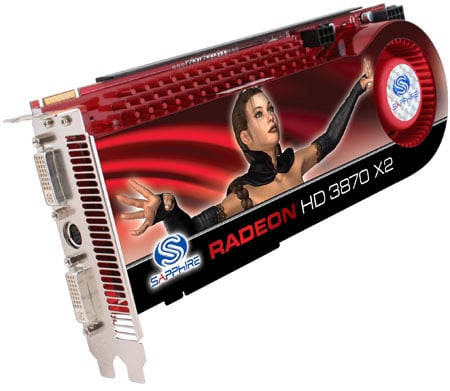
Sapphire ATI Radeon HD 3870 X2

Sapphire's ATI Radeon HD 3870 X2: one board, two GPUs

The answer is CrossFire on a single graphics card, and here’s the AMD recipe for success. Take two HD 3870 chips - reviewed here - and two batches of 512MB of GDDR 3 memory. Add a PCI Express 1.1 bridge chip, mix the whole lot together on a 263mm-long graphics card and - bingo - you’ve got the X2.

You won’t be surprised to learn that the specification of the X2 bears an uncanny resemblance to a pair of HD 3870s while the appearance is very much like a 3870 with an extra couple of inches tacked on the length. While Sapphire’s first take on the X2 is a reference design, Asus has done something that is most unusual by producing an X2 with four DVI ports.

The X2's GPUs are made using the same 55nm production process as the HD 3870, and they support DirectX 10.1 and Shader Model 4.1, and have 320 Stream Processors in each chip. That’s 640 Stream Processors in total with a transistor count that has climbed past 1.3 billion. Each GPU has 512MB of GDDR 3 memory to itself, connected to its own 256-bit controller, so there’s 1GB in total.

The card is longer than a regular HD 3870 board, but it looks very similar and has the same beefy heatsink along the full length of the card, with a dust-buster fan at the far end that draws cooling air from inside your PC case. The air is blown through the heatsink and exhausts through the vented bracket to the outside world.

The core speed of the X2 has been increased from the HD 3870's 775MHz to 825MHz, while the memory speed has decreased from 2250MHz to 1800MHz. The memory controller supports both GDDR 3 and GDDR 4 so it would be no surprise if a graphics card manufacturer was to come up with an X2 with 2GB of fast memory. Whether it would make any sense is a completely different question.

Latest Comments

Driver issues ...

I had two ATI cards in the past (7500 and 9500 based). Unless things have changed - you'll be waiting a long time for ATI to "straighten out" the drivers, because they didn't do a very good job back then, with (supposedly) "release) drivers.

One of the reasons I switched to nVidia. Haven't had nearly the driver agony since.

(I know some will say "That's all fixed now!" - but, well, it wasn't fixed when I had the cards. That whole thing about leaving a lasting impression ...)

0
0

Astronomical indeed

Yes!

I use a number of displays for testing including 19 and 24 inch TFTs but I also have a Taxan EV2285 CRT with a max resolution of 2048 x1536 which of course uses an analogue connection but it sure does look pretty.

0
0
Anonymous Coward

Astronomical

Do the Reg guys hook up a massive old CRT monitor to do the test at 2048 x 1536?

Just curious.

0
0

@ Alastair and Brian

Nvidia fan? oh please. Most high-end power supplies have a bunch of six-pin PCIe connectors but eight-pins are rarer than a rare thing. If you can provide a couple of make and model numbers that are appropriate to overclock the X2 then I'll eat my words.

Brian and Bus bandwidth: in principle you are correct with a great big 'However'

I don't know how much bandwidth a PCIe graphics card requires. I know the speed of PCIe 1.1 and 2.0 and how many lanes the various PCIe slots provide but I don't know how much bandwidth, say, a GeForce 8800GT requires. The Intel P35 chipset only supplies four lanes of PCIe 1.1 to the second graphics slot which is one quarter of the main slot and one eighth of the bandwidth of the PCIe Gen 2.0 slots you'll find on the latest crop of motherboards but even so it seems to be adequate in most cases.

Turning that the other way round a pair of HD 3870 cards in a single x16 slot a la X2 is the equivalent of eight lanes of PCIe per chip provided the bridge chip and drivers do their jobs correctly, in which case I doubt the graphics slot will be the bottleneck in performance.

0
0

Bus Bandwidth

I find it hard to believe that the reviewer has obviously overlooked the fact that this card is only supported by a single x16 PCIe slot, thus creating a bottleneck when the card is pushed to the limit.

The 2x 2900XT's have at least 1 x 16xPCIe +1x 8x PCIe slot creating 150% of the bus bandwidth to play with for highly intensive graphics.

I may be mistaken, the 2 x 2900XT's may have 2 16x PCIe's further improving bus throughput.

0
0

More from The Register

Android is a mess and needs sprucing up, admits chief
Can Google really fix it? It isn't in control any more
New Lumia 925: This, loyalists, is the BIG ONE you've waited for
Nokia veep drills high-end master plan for El Reg
Android device? Ooohhhh, you mean a Samsung phone
Koreans nabbed nearly all the Q1 profits – more even than Google
Review: HP Pavilion 14 Chromebook
All roads lead to Chrome?
Borked your iDevice? Pay EVEN MORE to have it fixed by Applecare
Or scream at their hapless techies on their forums
Euro PC shipments plummet into bottomless pit of DOOOOM
11th quarter of decline, 20pc drop on last year - Gartner
Report: AT&T dropping Facebook phone after dismal sales
Turns out folks won't buy that for a dollar