


This article is more than 1 year old
Asus EN8800GT/HTDP/1G 1GB graphics card
Nvidia's 'G92' gets a gig to play with

Review The headline feature of the Asus EN8800GT 1GB is - as the name suggests - the fact that it packs in 1GB of GDDR 3 memory instead of the 512MB that you’ll find on standard GeForce 8800 GT-based graphics cards.
When we unpacked the graphics card from the usual enormous Asus box, the memory did indeed grab our attention but not in the way that we expected. The 1GB is arranged in eight chips manufactured by Qimonda and each chip carries the legend HYB18H1G321A-11. The '1G' in the middle refers to the 1Gb density of each chip and the '11' suffix is presumably the rated speed in nanoseconds as 1.1ns equates to a true clock speed of 900MHz. That’s a DDR rating of 1800MHz which is exactly in line with the specification of the Asus.
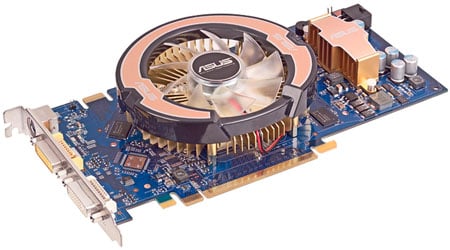
Asus' EN8800GT 1GB: double the memory of a typical 8800 GT
The point isn’t that we can cleverly decode the markings on a memory chip but rather that we were able to see the memory chips quite clearly. Asus has chosen an oval aluminium cooler with a large 80mm fan in place of the standard shroud-type cooler on this GT. The cooler is supported on four stand-offs and makes contact with the 'G92' graphics chip but leaves the memory chips bare, hence our ability to read the markings. Unlike an 8800 GTS, the mounting bracket on this card is a single-slot design. However, the height of the cooler means this GT is a double-slot card that blows hot air inside your PC case.
At start-up, the fan on a regular 8800 GT makes one heck of a din until the drivers kick in to slow it down. During operation it is very quiet indeed. The only downside that we can see with the usual 8800 GT design is the heat generated in the casing. We measured the casing temperature as 30°C with the Windows desktop running, rising to 55°C during a gaming session. This was with an open test system laid out on the bench.
By contrast, the Asus 1GB is quieter during start-up as the fan spins at a constant speed. Once Windows is running, the 1GB is the noisier of the two as the fan is audible. The cooler on the 1GB does a better job of keeping the GT under control as it runs at a consistent 25°C even under load.
 Biting the hand that feeds IT

