The Register® — Biting the hand that feeds IT

Feeds

The OLPC XO laptop

Is the mean, green thing hacker-friendly?

Review Originally known as the '$100 laptop' from the One Laptop Per Child (OLPC) project, the XO laptop is now available through retail. I bought one under the Give One, Get One program where for a $400 donation, OLPC would send one XO to the donator, and another to a child. This is my story of working with it for a couple of weeks.

Opening the laptop was the first challenge. Being an IT professional - I'm a system administrator - I decided I didn't need to read the documents, and was promptly stymied by an inability to get the laptop open. A Google search revealed what the document I had tossed aside without reading showed: to open the laptop, first swing out the antennae, and open it from the opposite side of the handle. This may sound easy, but the majority of people who tried to open it weren't able to do so without being shown how, either.
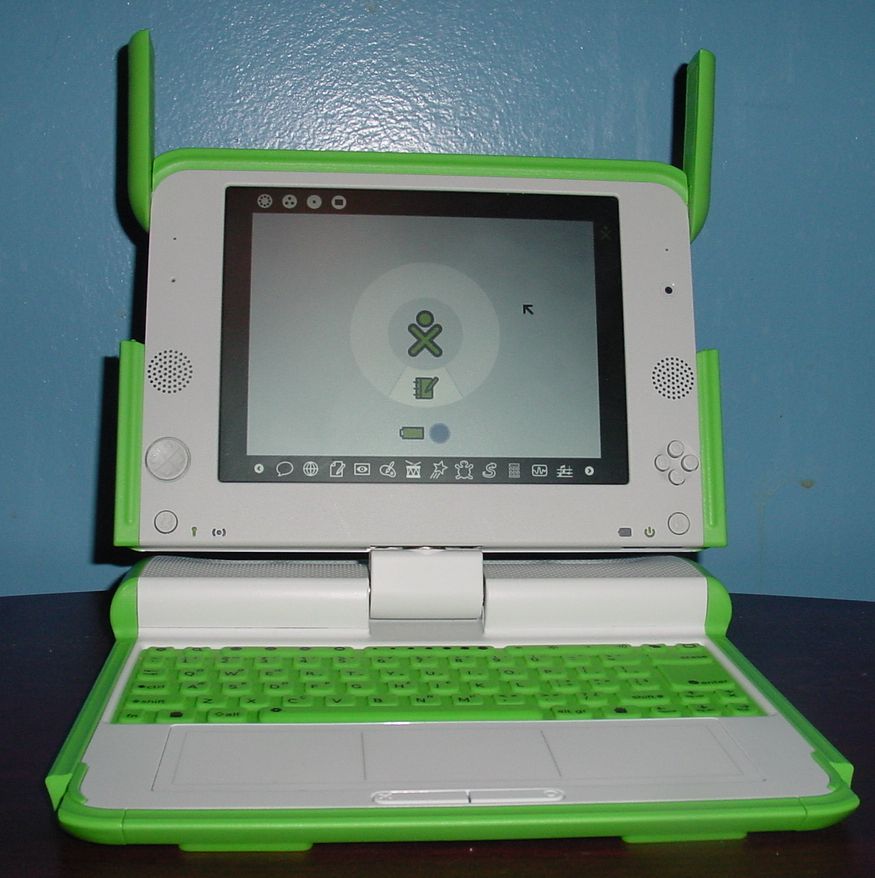
The XO Laptop

OLPC's XO: opening challenge

The CPU is a Geode LX-700 from AMD running at 433MHz, with 256MB Ram and a 1GB built-in Flash drive. There are three USB ports, plus microphone and headphone jacks on the sides of the screen, and an SD card slot on the underside. Accessing the SD slot is a pain that requires pivoting the screen 90° and then turning the laptop over. The XO has Wi-Fi, but no Ethernet port. I found the speakers to be loud but more tinny sounding than those on, say, the Asus Eee. The XO also has a built-in 0.3-megapixel quality webcam.

The screen is 7.5 inches wide, and has two modes: indoor backlit color and outdoor black and white reflective. The backlit mode gives 800 x 600 resolution, and the outdoor 1200 x 900. The monitor pivots around for 'eBook' mode, and a button on the front rotates the screen 90° with each push. The game key pad and buttons double as page up/down and cursor movement keys.
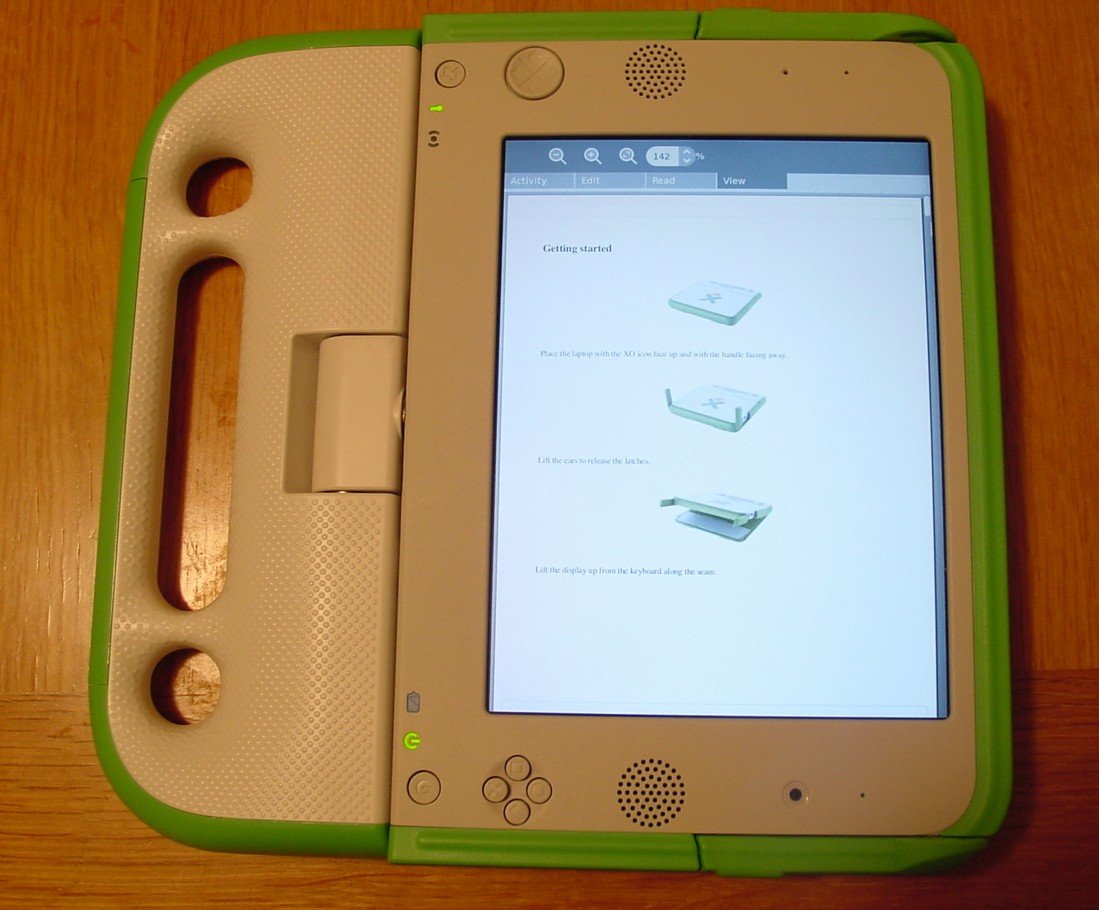
The XO Laptop in ebook mode

The XO Laptop in eBook mode
Click to see the whole screen

The keyboard is small - this is a kid's laptop, after all - but it is still bigger than many devices where adults need to enter text. The keys are rubberised, and there is enough space between them to (usually) avoid hitting the wrong one. Touch-typing is slow, but possible. Using three fingers on each hand for all but the edge keys worked pretty well.

The layout is good, with the enter key being four times the size of most keys, and the erase being twice as large. There are no Caps Lock or Delete keys, but holding FN and backspace will delete to the right of the cursor.
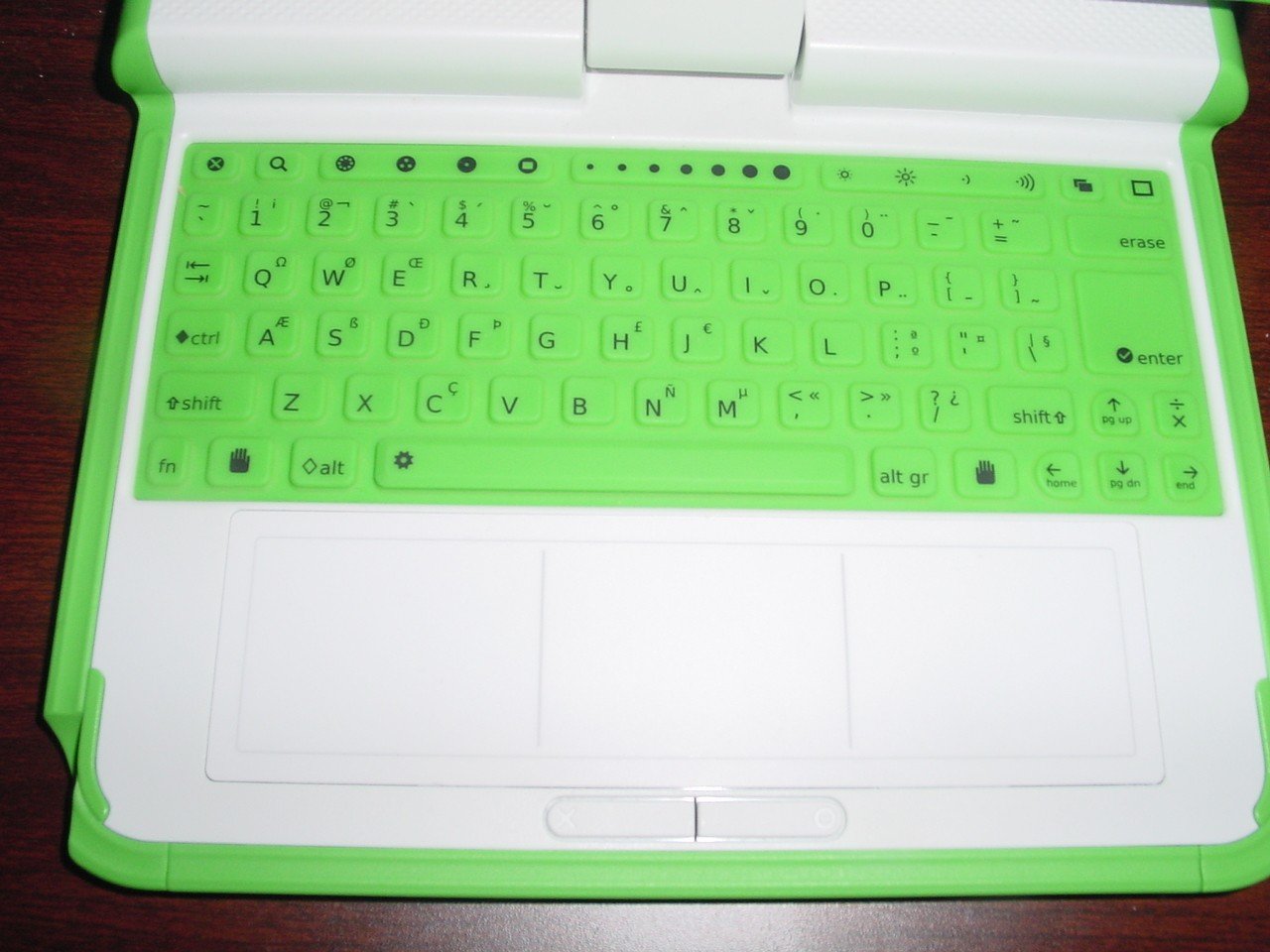
The XO Laptop's keyboard - click for a wider view

The XO Laptop's keyboard
Click for a wider view

The unit is totally silent. The lack of a fan and spinning hard disk, combined with the silence of the rubber keyboard, makes for a strangely quiet computing experience. The XO also runs cool, with the back of the screen becoming only slightly warm after hours of use, while the base remains room temperature.

Next page: Battery and boot-time

Latest Comments

Eee PC FTW.

Maybe what they should do is ruggedize/childproof a low end EEE PC instead, or just rework the installed software. As much as I dislike the fact the EEE PC base 'nix is Xandros, it does work quite well.

It sounds like the bundled software on this OLPC is far from ideal.

0
0

Read the "Case Study" of Arahuay Before Opinionating

As posted by "Jansen":

http://wiki.laptop.org/go/OLPC_Peru/Arahuay

I find it impressive in detailing the XO's impact, but it also highlights the importance of structural preparation and support within the country receiving the XO's. There has to be some kind of educational infrastructure and context in which to integrate the XO. These machines cannot just be "thrown" at the students in hopes something magical will happen - it does take supporting effort, and it seems Peru is making that effort, as well as providing valuable feedback to OLPC to improve the XO, which it seems to have taken seriously.

My wife teaches first grade at a North Carolina inner-city school, and had her eyes opened a bit as to what "underprivleged" means in a non-American context. She has kids on welfare with no parental interest (or often even presence) who would be considered "wealthy" by the Peruvian kids who have received XO's with a great deal of gratitude and keen interest.

I doubt a number of her students would be nearly as appreciative or motivated by an XO because they have been spoiled by ready access to technology for purely entertainment purposes even if they don't have decent housing/clothing/medical care/etc by (US "standards"). It is all a matter of context.

We have ordered an XO with the "Give One, Get One" program to see if it could be of use in her context. I can provide the Linux support, and she uses Mint Linux at home on an almost constant basis (strictly as a "Gnome end-user" ;-), so it should be "interesting".

Think outside the box, but focus on the objective here of bringing the enabling technology to those who have not had any such exposure before. The Arahuay example is very instructive in how much can be accomplished when done right. It remains to be seen how sustainable the effort is, and how well it can be replicated in other locales. It needs CONSTRUCTIVE criticism to succeed, and not just nay-saying based on pre-conceived notions.

ROC

0
0

@Andre

I maintain the effort is *useless* without proper support -- training, maintenance, reposition, content creation in Portuguese -- do you trust our government to do it? Without it how is it going to reduce the digital divide?

It is just yet another waste of money from a government that likes to be seen doing things.

xjy got it right -- solving illiteracy is way more important. Ability to learn and use knowledge is a far more effective tool for citizenship than a shiny nifty probably-unsupported toy.

0
0

Politics not technology

Supplying technology like this is a charity solution. The problems facing the people in exploited countries are political, and can't be solved by charity. However, the impact of any useful technology, however it's acquired - like pens and paper, or literacy - in a fertile political setting can be explosive. Brazil is a perfect example of this, with excellent theory and even some practice in place for getting the most out of the desire of poor people to empower themselves. Like Freire's work.

Like China, Brazil could easily design and manufacture its own solutions to technological challenges. But to do this it would need to throw out the multinational leeches (who try and threaten workers in Sao Paulo with "outsourcing" their jobs to the poor north-east of the same country), and repudiate its fake debts to the imperialist banks. While Lula is president this won't happen, and Brazil will just be another India. Damn it all, haircuts cost you more in Sao Paulo than they do in f**king Epsom.

The Amazon isn't a puddle in the street, but charity would like us to see the problem of international poverty in that way. Fortunately the people on the sharp end of imperialist gouging are more realistic about charity than those of us in the first world who just get ground down by the blunt end.

0
0

Re: We should be ahsamed

Soif you really ARE from a country where the XO is meant for,why the feck should you be saynig "we"???

Ooh, yeah. I loce the smell of fresh MS astroturf in the morning...

0
0

More from The Register

Android is a mess and needs sprucing up, admits chief
Can Google really fix it? It isn't in control any more
New Lumia 925: This, loyalists, is the BIG ONE you've waited for
Nokia veep drills high-end master plan for El Reg
Android device? Ooohhhh, you mean a Samsung phone
Koreans nabbed nearly all the Q1 profits – more even than Google
Review: HP Pavilion 14 Chromebook
All roads lead to Chrome?
Borked your iDevice? Pay EVEN MORE to have it fixed by Applecare
Or scream at their hapless techies on their forums
Euro PC shipments plummet into bottomless pit of DOOOOM
11th quarter of decline, 20pc drop on last year - Gartner
MIT takes battery-powered robot cheetah for a gallop
Biomimetic big cat needs no power cord, just a walker