Japan scores ballistic missile shootdown bullseye
Navy Self-defence force in 100-mile-high skeet shoot
Cloud storage: Lower cost and increase uptime
Japan has become the second nation to acquire functioning ballistic-missile defence equipment, carrying out a successful shootdown yesterday. A target rocket representing a medium-range enemy missile was engaged and destroyed 100 miles above the Pacific by a Standard SM-3 interceptor fired from a Japanese warship, JS Kongo. The target took off from the US Navy missile range facility on Kauai, Hawaii.
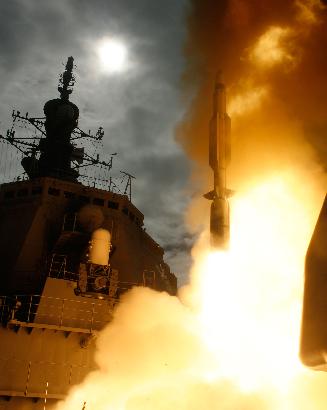
JS Kongo pops one off.
The Japanese Maritime Self-Defence Force (JMSDF, the title given to the country's navy after World War II) has operated destroyers carrying US Aegis air-defence technology for some time. In 2003, the JMSDF was authorised to upgrade its ships with the latest SM-3 interceptor weapons and tracking kit. This gear has been developed by America for shooting down short and medium-range, Scud-type ballistic missiles of the kind found in the arsenals of many minor powers. The SM-3 can't pick off a true, triple-stage intercontinental missile - ICBMs fly too high - but the Aegis radar can help to track such threats.
Japan has moved to acquire Aegis missile defences in response to menacing moves by North Korea in recent years, which have included firing a "test" weapon right over Japan into the Pacific. Kongo-class ships deployed west of Japan could offer a useful defence against the current North Korean armoury, though Kim Jong-Il's regime is working on a proper ICBM.
Aegis and Standard gear is made by Boeing, at considerable cost. Yesterday's shootdown was the 12th score for SM-3 in testing, the company said.
"This successful test brings a new level of defensive capability and security for our ally Japan," added Debra Rub-Zenko, Boeing veep.
"We will continue to strive to increase the system's credibility," Japanese Defence Minister Shigeru Ishiba told AFP.
"We can't talk about how much money should be spent when human lives are at stake."
The news wire said, however, that the missile-interceptor test had "outraged peace activists" in Japan, and quoted Tokyo professor Yoshikazu Sakamoto as saying that it could arouse "suspicion in enemy countries".
A number of other countries have equipped their navies with Aegis equipment from America, including Spain and South Korea. They too could potentially acquire similar Scud-buster upgrades. ®
COMMENTS
@ John and Richard Simpson
I have to add my 2 cents.
Orwell was technically correct...enough AA would keep bombers from being effective for a few reasons. The first (and more myopic) is that enough AA would cause so much havoc with the bomber formations that Germany would not have been able to field an effective flight of aircraft if, say, they were losing 50-100 craft and crews at a throw. Technically true, but then how much AA would be enough to effect this result? Obviously, more than Britain had in its standing defense force, and even that was probably less than a 1/10 of what would be necessary to bring those kind of numbers about. England would have had to have been encrusted with AA from the coast to the middle of strategic population centers such that inbound aircraft would be getting hammered all the way in and all the way out.
As it was, there was a fair amount of artillery, but located in concentrations relatively close to the cities they were defending. The standing Air Corps had to take up the slack with very few aircraft relative to the early German inbound filghts. Thus, Germany sends planes in, but are losing too few to justify suspending operations, continuing a bombing campaign for several years. That is parts of the economics of warfare that Orwell apparently didn't reconcile.
As far as service ceilings, you are technically correct. The problem was that aircrews typically flew far below those ceilings for several reasons. German aircraft, good as they were, were usually designed as multirole aircraft. As such, few were actually flown below their optimum configuration. Plus, in the case of Germany, they relied primarily on twin engined aircraft which are very subject to the laws of ballistics and smaller in bombload, thus needing far more aircraft to do the same job of a Lancaster or B-17 detachment. Had Hitler approved construction of high-altitude heavies early on, things could have been a whole lot worse (if one could even imagine that) for the inhabitants of Britain.
All that aside, the primary reason that aircraft operated below the threshold that would have put them out of reach of flak (and most fighters) was that although the Norden bombsight and others could calc the physics of falling bodies at any altitude/speed...the bombs had troubles hitting home even at 10-15 thousand feet. The reason was not known until after WWII. The physics of falling bodies was tight, but those in know had no idea that the "jet stream" existed, much less that winds often change direction significantly every 5-10 thousand feet. In fact, the Lancastrian that smacked the mountains in Chile in 1948 (maybe Peru), the aircrew flew in on-off poor visibilty and ended up plotting course by compass and airspeed. They knew they had the altitude, however when they plotted for calc airspeed, the came up 100+ miles short and started their descent straight into the mountains they thought that they had flown over. What they didn't know was they were flying into a severe headwind caused by the jet stream.
High altitude bombing was considered the best bet early on in the war, but was wildly ineffective even with huge formations. I have read several accounts where the accuracy of bombing campaigns was calculated as low as 8% and and "high" as 25% on good days. Actual effects on the bombs were not calculated as they fell towards earth simply because no-one knew there were effects to be calculated outside the physics of the blackboard. To sum up, when accuracy had to be maintained, the operation ceiling of the group generally lowered. Because of the inherent problems of getting it in the pickle barrel, you have huge formations to carpet bomb high value targets instead of a few super-accurate bomb strikes made by a few aircraft. As such, one can see why '17s, '24s and Lancs were getting plinked throughout the war. Even the Superfortresses during WWII and Korea were suffering the same fates (much of it was due to the plane itself) though they were constructed to fly very high and very fast out of the reach of everything...but their bombs hit targets more out of pure luck at those heights than for any other reason.
I'll shut up now. Just had to throw my 2 cents in. I should keep those pennies though....they are becoming more valuable for their metal compostion than their face value.
@stuart ward
If i understand the article right, spain only has the aegis tracking system, not those missiles. You can do a lot of actually interesting stuff with such a system (as opposed to star wars), you know. Like studying bird movements, or in the case of spain maybe finding immigrant boats.
North Korea hates Japan and the Japanese know that
North Korea still holds a grudge against Japan for what they did before and during WWII so they have full justification for buying into this system to protect themselves. As it is NK can already plop a bomb with who-knows-what-kind-of-warhead anywhere in Japan and this can maybe stop that.
As for the defense system doing nothing to defend America I can tellyou, having been stationed in Okinawa for over 2 years, that many thousands of Americans live there as well as on mainland Japan and are also within reach of NK's missiles.

Agentless Backup is Not a Myth
Steps to Take Before Choosing a Business Continuity Partner
Requirements Checklist for Choosing a Cloud Backup and Recovery Service Provider
Cloud storage: Lower cost and increase uptime
SaaS data loss: The problem you didn’t know you had