The Register® — Biting the hand that feeds IT

Feeds

Telly vision: future display technologies

Coming soon to a screen near you...

Feature Karl Ferdinand Braun could never have imagined how fiercely competitive and technologically advanced the global market for displaying still and moving images on a screen would become during the hundred or so years since he created the Cathode Ray Tube (CRT).

But in a world where CRT once reigned supreme, Liquid Crystal Display (LCD), plasma and Digital Light Projection (DLP) TVs have taken its place. Plenty of CRTs are sold each year, but it's clear that the technology's days are numbered.
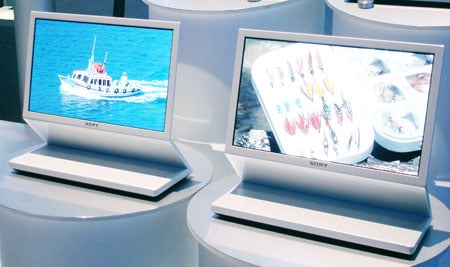
sony 'super top emission' oled tv panels
Several OLED TVs, yesterday

But how long have its successors got left to them? LCD, plasma and DLP offer some key advantages over CRT: they can be made much thinner, and can scale to bigger screen sizes and larger resolutions. But for all the advancements made to each technology, a fair few viewers believe - with good reason - that clunky old CRT TVs still produce better pictures.

That means there's a gap in the market for a flat-panel display that can present a moving picture that's as bright and as blur-free as a CRT but also supports the high resolutions only LCD, DLP and plasma can provide.

So what technology might such a screen use? Enter a whole new set of acronyms to encounter: OLED, SED and LCoS. Not to mention the positively Star Wars-sounding laser TV...

OLED

The development of OLED technology stretches right back to the 1950s, but the first demonstration of the kind of screens we know today took place in 1996. The technique utilises organic compounds that generate light when they're fed with an electric current. Deposit tiny drops of a given compound onto a glass or plastic panel and sandwich it between a grid of positive and negative electrodes and you've got a simple, single colour OLED panel. Combine three of these into one and you have the basis for a three-colour - red, green and blue - panel capable of displaying colour pictures.
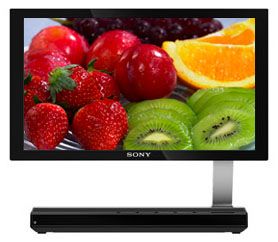
Sony XEL-1 OLED TV
Sony's XEL-1 OLED TV

Because OLED panels generate their own light, they don't need a separate light source the way an LCD panel does. That not only helps reduce their power consumption - up to 40 per cent less than LCD, it's claimed - but leads to better colour reproduction. The trouble with a backlight is that it's always lit no matter how few pixels are showing a colour other than black. OLED pixels only consume power when they're lit.

Latest Comments
Anonymous Coward

Samsung prototype

Samsung brought out a handsome-looking prototype 40-inch OLED TV a couple of years ago. Has anyone heard anything about progress from Samsung on this?

0
0

Tomorrows World Russian demo

Anyone remember the LASER TV demonstrated on TW many years ago?

It consisted of a disc of lasing crystals the were energised by a CRT scan from the back. The picture was always 'in focus' but the demo was only in sepia - diffferent colour lasing was not demonstrated. Or did I dream the whole thing.I think it was shortly after the Soviet Union collapsed.

0
0

GOOD CALL ON C R T MONITORS & TV SETS

The mindless techno freeks are the ones

feeding fires of big industry, shure tech advances

are to be because life goes on.

but the life times of the new video displays really

suck. i do not personally plan to replace my C R T'S

just because they are not the latest & greatest thing

to go and >>SPEND MONEY ON<< as that is what big

industry wants .

has anyone ever taken into account that the new tech

items COST- MORE TO BUY , AND HAVE SHORTER

LIFE SPANS HMMMMMM WONDER WHY= big buisness

GREED. they dont care about the consumer but they do

care about there bottom line & there proffitt's from the junk

they continue to get the masses hooked on with some fancy

EYE CANDY.

an OLED display is a wonderfull thing for BLOW & THROW junk

some where it must have printed on it MADE BY KLEENEX as

that is the original HI TECH BLOW & THROW necessity.

if you keep several C R T monitors remember to power them on

for several minutes each week to keep the capacitors & CRT tube

its self from going soft.

i to have several C R T type monitor spares and will continue

to keep them as long as i can BECAUSE IT CAN BE >FIXED<

when they break UN LIKE THE NEW BLOW & THROW >JUNK<!!

0
0
Anonymous Coward

CRT's

right so none of this is any good compared to a CRT I can watch beautiful full screen video and my dad who has a flat screen LCD gets fuzz both PC monitors one cost a lot more than the other (the LCD is more) and still does I will hoard CRT's I am not young and so I will have the best viewing technology around until I die Plasma screens at one point were supposed to last about three years which is ridiculous for how much they still cost you know none of these new screen techs are worth a shit and yet I still see mindless eager rubes drooling over them.

0
0

Laser Projectors

Well when you want a projection device built into your mobi, I think laser is the only option, and to be fair a bit of sparkle can be tolerated in this usage, highly mobile/demonstartion only type package, I can see LCoS & laser being a perfect in chip package.

0
0

More from The Register

Is the next-gen console war already One?
Microsoft’s new Xbox - and more
 breaking news
Apple cored: Samsung sells 10 million Galaxy S4 in a month
Beware of South Koreans bearing Android
US boffin builds 32-way Raspberry Pi cluster
Beowulf cluster built for the price of a single PC
STROKE this mouse to make apps POP, says Microsoft
Windows 8 Start button comes to Redmond's rodents
Nintendo throws flaming legal barrel at YouTubing fans
All your walk-through vid revenue are belong to us
Fairphone goes on sale to all
The Android handset that's PC can be yours

Hands on with Hyper-V 3.0 and virtual machine movement

Our award-winning Regcasts have teamed up with training provider QA for the deepest of deep dives into Hyper-V, including a live demo.

Understand VM movement - just click to play, or go here for a bigger version.