


This article is more than 1 year old
Dawn on its way to the asteroid belt
Lift off, at last

Dawn, NASA's mission to the asteroid belt, has at last launched successfully. At the time of writing, NASA mission managers were still waiting for the Delta II's second and third stages to fire, but so far it is all looking good.
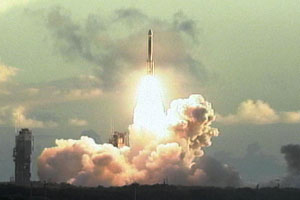
Lift Off! Image credit: NASA
Dawn was originally slated to depart early this summer, but lightning storms kept it pinned down on the launch pad. The most recent delay was to allow more time to fill the rocket's second stage, bad weather having forced engineers inside.
But Dawn is finally on its way. Now it has to travel across the inner solar system to the asteroid belt, located between Mars and Jupiter. Scientists think the asteroid belt is full of the debris from the formation of planets.
Dawn is on its way to study Ceres, officially a dwarf planet and the largest body in the asteroid belt, like Pluto, which it will reach in 2015. Ceres is thought to hold a layer of water ice roughly 40km below its surface. But first it will stop off at Vesta, a large asteroid roughly half the size of Ceres. It should reach this target as soon as 2011.
The two targets are very different from one another, and are thought to have been formed by totally different processes. NASA describes them as a bridge from the rocky bodies of the inner solar system to the icy regions of the gas giants.
Vesta is a rocky body, whose surface seems to be basaltic rock, or frozen lava. It has a giant crater at one of its poles, created by a massive collision millions of years ago. This smash blasted out some 200,000 miles of rock that scientists believe are responsible for roughly five per cent of all asteroids we find on Earth.
Ceres, meanwhile, is believed to contain large quantities of ice. If only 25 per cent of its mass is water ice, it would hold more fresh water than there is on Earth. Some researchers believe it is not only possible that the dwarf planet holds ice, but that liquid water may flow beneath its frozen crust. It is also possible that it has frozen poles.
Dawn's goal is to work out what processes were involved in the formation of Vesta and Ceres, and hence the early dynamics of our solar system as a whole. ®
 Biting the hand that feeds IT

