


This article is more than 1 year old
Brazilian physicists boycott Dell
'Don't ask, don't Dell' policy

A group of Brazilian physicists is trying to launch a boycott by the country's academic community to fight Dell Computer's war on terror.
The campaign is a response to Dell's security checks, which take a hard line against Anti-American scheming with an impregnable barrier of drop down options and radio buttons.
The story was first reported by Brazil's daily Folha de Sao Paulo, and spotted by the folks at The Economic Times
Dell's methods quite reasonably depend on the honesty and forthrightness of Enemies of Freedom™ to identify their intentions to use Dell products in the production of weapons of mass destruction. When a customer proceeds to checkout, they get hit with a probe such as this:
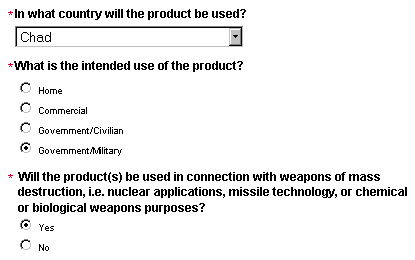 |
Still, it beats waterboarding.
Dell demands its products not be handed over to citizens of Cuba, Iran, Sudan, Libya, North Korea and Syria, and others deemed hostile to the United States. The company says the export compliance document is a standard government requirement. But Brazilian nuclear physicist Paulo Gomes of the Federal Fluminense University isn't satisfied.
"I do not have to justify my actions before anyone, and I am not obliged to follow US policies. I am a buyer. I am not receiving a donation. Besides, I have ties with Cuban physicists and will not renounce those," he said.
Gomes will return the two computers if Dell provides a refund and sends a letter to the Physics Institute at UFF justifying the restrictions, The Economic Times reports.
Gomes sent a report on his displeasure to the Brazilian Minister of Science and Technology and the Brazilian Physics Society to recommend the boycott to its members. ®
 Biting the hand that feeds IT

