MS, Mitsubishi tout translucent touchscreen concept
Apple got there first?
What you need to know about cloud backup
From the Archive And it sounded such a smart idea too. Microsoft and Mitsubishi are developing a 'translucent' touchscreen. The idea: touching the back of the panel controls user interface elements displayed on the front. Cute, but the question to be asked is: where do all the electronics go?
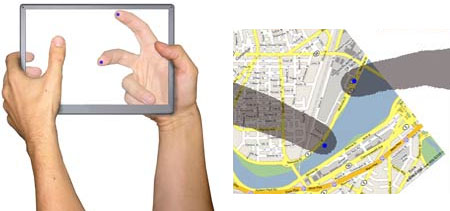
Apple's 'translucent' iPod panel patent (left) and Microsoft/Mitsubishi's 'translucent' touchscreen concept
The two companies call the system LucidTouch, MIT Technology Review reports. As the picture shows, the notion behind LucidTouch is the ability to hold the panel in two hands and still control it. Today's touchpanels, by contrast, require users to hold them with one hand, and point and click with the other.
The translucency in the concept is real, but in the prototype screen the two companies have built it's virtual: a webcam on the back feeds the main display, its image being mirrored to look right when it's shown on the front of the panel.
LucidTouch also operates like a standard touch panel, so users can still interact with the screen in the usual way.
The snag here is clear - literally. Today's handheld touchpanels sit on top of a whole mess of electronics - processors, hard drives, memory, system logic and so on - all of which are going to have to be crammed into the display's bezel if Microsoft and Mitsubishi are ever to get the concept off the ground. The prototype sweeps such complications under the virtual rug of a desktop PC.
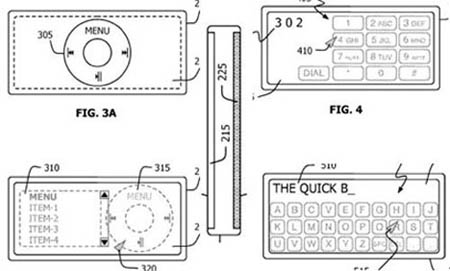
Apple's 'translucent' iPod panel patent
Microsoft and Mitsubishi aren't alone in conceptualising such a system. Earlier this year, it emerged that Apple has filed a patent application the details a similar approach to allow, say, an iPod owner to control the device one-handed, manipulating virtual controls displayed on the front of the player either by touching them directly or by tapping the back of the device with an index finger.
COMMENTS
re: B&O
you refer to the BeoLink 5000 i think. which did indeed have a transparent lcd display at the top of the remote control to tell you what av source you had selected and the channel etc that was playing. however it wasn't touch sensitive. it did have buttons on front and back, but they were normal buttons on the main part of the controller, not used via the lcd display
http://www.beoworld.org/prod_details.asp?pid=696
however, it wasn't a patch on the BeoLink 7000 that was just the best thing in the whole wide world
Nothing new under the sun!
Didn't B&O have a remote for one of their stereo systems that worked in a similar way about 15 years ago!
The MS/Mitsubishi solution is practical at least because the "fingers" are virtual... they're not literally visible (as in the Apple patent... which assumes they can somehow fit all the electronics in the bezel - as B&O did) ... they are a graphical overlay based on the camera view...
As a UMPC user I'd love to see this made real/practical (without the camera on a stick out the back!)
Doesn't look difficult to me...
Isn't this basically going to be like an old OHP LCD panel with a touch panel stuck on each side?
The bezel might be a bit bulky, but nothing particularly problematic.
Fitting the CPU, storage etc. into the bezel could be difficult, but depending on the device they wouldn't have to be huge. And there's always the option of having the processor remote, and connected via a cable or a wireless link.
And the software to drive everything isn't complicated.
A fully working prototype would probably be the work of a couple of weeks.
The only thing is though that this looks like it might not actually be worth doing - I suspect that while it may look cool as a tech demo, there isn't any particularly good argument for something like this - what exactly does it do better than a plain old conventional touch panel? Nothing I can think of, though I can see lots of ways it would be worse.

IT infrastructure monitoring strategies
What you need to know about cloud backup
Enabling efficient data center monitoring
Agentless Backup is Not a Myth
Top 10 SIEM implementer’s checklist