The Register® — Biting the hand that feeds IT

Feeds

Compact Disc: 25 years old today

First commercial disc pressed on 17 August 1982

  • print
  • alert

Forgotten Tech The Compact Disc is 25 years old. Though the digital audio format's development stretches back many years before 17 August 1982, that was the date on which the world's first CD pressing plant punched out its very first disc.

CD logo

According to Philips - with Sony, the format's co-developer - the first disc off the Hanover, Germany production line was Abba's The Visitors.

While CD production commenced in August 1982, the format wasn't formally brought to market until November, and then only in Japan. US and European music lovers had to wait until March 1983 for the first discs specifically tailored for them.
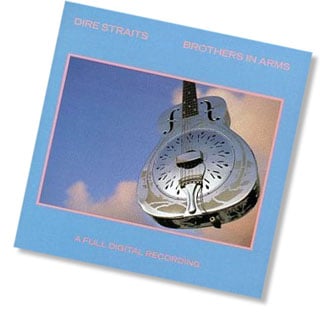
Dire Straits' Brothers in Arms
Dire Straits' Brothers in Arms: all-digital

They embraced the format wholeheartedly. In the UK, Dire Straits' 1985-released Brothers in Arms was immediately snatched up by early adopters keen to put their new CD players through their paces. It was one of the first CDs produced from a digital master made from digital recordings - a so-called 'DDD' album.

But other albums proved even more popular. For many years, it was claimed record label EMI had a single CD pressing plant to producing copies of Pink Floyd's Dark Side of the Moon, such was the demand for that album. Dark Side of the Moon remains the archetypal CD album - who wants to get up and turn an LP over when you're happily getting intergalactic to the Floyd's spaced-out sounds?

Latest Comments

I Know It's A Bit Late But.........

cd 25 years old being phased out

vinyl donkeys years old still around and has a huge following

vinyl has won

no argument

also nothing beats shaped/picture/transparent/all 3 disks

0
0

Best amps made

Some of the best transistor amplifiers you will find are the ones made in the days when they had to compete with valves. Come to think of it, even the valve amps made in those days were better, because they were competing with transistors. (My old valve amp -- ECC83 and two ECL82s per channel in class AB1, feedback via secondary of output transformer -- really doesn't like MP3s at all. I thought it was just a very bad case of tube fatigue, but a CD sounded fine through it.)

I guess it's true; when you've got nothing to prove anymore, you don't try as hard.

I made some rips from analogue cassettes and LPs, but they were always marred by noise. I eventually cured this by getting a USB mixer (i.e. with integral sound card); it has its own power supply, and so is not sharing with the computer. There's no proper RIAA equalisation, but there are separate treble, middle and bass controls for each channel and I found a reasonable setting by trial and error.

The LP record, imperfect as it is, needs to be viewed in context as part of the entire system for delivering sound from the performer to the listener. The distortions introduced by the recording and playback of vinyl records are expected by the listener, and "vinyl noise" is an integral part of the listening experience. This is not something you can expect kids who've never grown up with it to understand.

@Cliff: Piano rolls do still exist, only they're called Midi files nowadays.

@Vulpes Vulpes: You're dead right; CD boxes are no good for skinning up on. Perhaps that explains why today's youth are so into bongs.

0
0

Cheap CD players are still naff

Because of the Nyquist filter. You can't just pipe the output of the D-to-A converter to your amplifier, you need to filter off the sampling artifacts, and remove the ultrasonic content which can cause some amps to give you high-frequency intermodulation distortion. CD players have had various schemes for doing this ("1-bit converter", "n-times-oversampling" "DSP" etc.,etc) but cheaper or more poorly designed ones don't perform this well. Also, the nature of the filters can give you a high-end frequency response that isn't flat, and do nasty things to the phase as well.

The upshot of this is the well-known "listener fatigue" effect of listening to some CD players. What you are experiencing is the high-frequency distortions, which you can't consciously identify, giving a subtle jangly effect to vocals, cymbals and other "tizzy" stuff.

The effect is made more horrible by the tendency for modern music CD's to have gallons of treble boost applied, to make the music stand out on small radios and in clubs. Yuk.

0
0

What about the 3 sided LP?

Monty Python released a 3 sided LP once. One side had 2 concentric tracks so you randomly got one of the two tracks depending upon whichever the needle picked up on the lead-in.

Try doing that with a CD, MP3 or other digital format...

0
0
Anonymous Coward

LP -> CD improves quality

I've just had a hundred ancient LPs transferred to CD for my father (87). He is utterly amazed at the huge improvement in quality. He believes that they sound better than the original LP when new.

Of course the transfer was done with a first rate turntable on newly cleaned records with attention paid to get the proper balance. He has a really cruddy twenty year old turntable with the same needle it was bought with.

It is amazing that the LPs are in good enough condition to produce the copies - but I must say that I agree that the quality is extremely good, now that they are transferred to CD. This is probably the best solution - play LPs once, onto CD....

0
0

More from The Register

Is the next-gen console war already One?
Microsoft’s new Xbox - and more
 breaking news
Apple cored: Samsung sells 10 million Galaxy S4 in a month
Beware of South Koreans bearing Android
US boffin builds 32-way Raspberry Pi cluster
Beowulf cluster built for the price of a single PC
STROKE this mouse to make apps POP, says Microsoft
Windows 8 Start button comes to Redmond's rodents
Nintendo throws flaming legal barrel at YouTubing fans
All your walk-through vid revenue are belong to us
Fairphone goes on sale to all
The Android handset that's PC can be yours
Microsoft reveals Xbox One, the console that can read your heartbeat
Upgrades Live service – and no always-on requirement

Hands on with Hyper-V 3.0 and virtual machine movement

Our award-winning Regcasts have teamed up with training provider QA for the deepest of deep dives into Hyper-V, including a live demo.

Understand VM movement - just click to play, or go here for a bigger version.