NASA examining Shuttle's dings, extending mission
All go up on the space station
Cloud storage: Lower cost and increase uptime
Mission controllers at NASA are inspecting some damage to the shuttle Endeavour's heat shield sustained during the "flawless" launch last week.
Before docking with the International Space Station (ISS), the shuttle performed a now-routine flip to allow the ground crew at mission control to inspect the craft for damage. The eagle-eyed boffins spotted five dings in the insulating tiles.
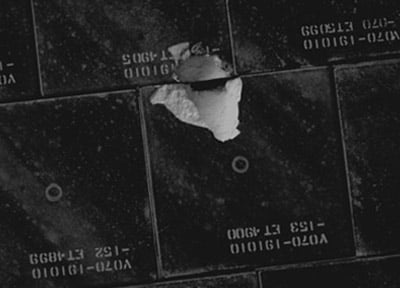
Damage to Endeavour's heat shield. Credit: NASA
Four of the five have been deemed unlikely to pose a threat to the shuttle during re-entry, but one is suspect. Now Endeavour's crew is taking a closer look to determine the exact size of the void. This data will be used to work out whether or not the shuttle can withstand the furious heat of reentry without undergoing repairs.
NASA says nine pieces of foam broke away from the fuel tanks as the shuttle launched. Managers think one of these may have hit the tiles as it fell away, causing the damage.
NASA has also elected to extend Endeavour's mission to 14 days, only possible because the shuttle has been drawing power from the space station for the last five days.
The extra time means the crew will be able to add a fourth spacewalk to their schedule (not including any possible excursion for repairs). The astronauts will install equipment used to stow the Orbiter Boom Sensor System at the station between shuttle flights.
Mission specialists Rick Mastracchio and Dave Williams are scheduled to take the second space walk of the mission today (10:30am, CDT), during which they will replace a control moment gyroscope that was shut down when it failed in October last year. ®
COMMENTS
what could have been
the shuttle was designed to be taken to near space by a lifting body, a sort of super jumbo, not these great big fire works they now have, light and forget.
the posh name was HTHL, horezontal take off , horizontal landing.
http://en.wikipedia.org/wiki/Lifting_body
so the tiles being brittle did not matter so much, as they were protected by the slow take off speed and gentle handeling, and very light was an advantage,
Then cost cuts come in, and hay presto, you make the typical engineering decision, the best of a bad job.
The tiles have never been covered or painted. The external tank was origionaly painted, but bits flaked off even then. The major problem seems to be Ice, formed around the tanks, which has always been a problem using super cool stuff like LOX and H2. look back at the apollo launch films, you will see ice every where.
http://www.youtube.com/watch?v=5Vc4X4hKuAc&mode=related&search=
re: Foam > Ceramic
To simplify what Robin said above:
Yes. At 5, 10, or 15K mph, impacts from foam will cause damage to just about any surface, even if it's just a glancing blow like the impact that caused the hole in the picture.
hypersonic foam
re: Foam > Ceramic:
When that foam breaks off it is rapidly decelerated in the slipstream and hits those tiles as some rate of knots (insert SI unit as desired ;) The ceramic tiles themselves are a sort of ceramic foam, something a lot weaker than your dinner service.
"[the tiles] consist of fine glass fibers organized in an open cellular pattern, so that tiny spaces account for 95% of their volume".
http://helios.augustana.edu/astronomy/space-shuttle-tiles.html
Re: Great close up:
That pic was taken from the ISS, that's why they do the backflip before docking.

Agentless Backup is Not a Myth
Steps to Take Before Choosing a Business Continuity Partner
Requirements Checklist for Choosing a Cloud Backup and Recovery Service Provider
Cloud storage: Lower cost and increase uptime
SaaS data loss: The problem you didn’t know you had