AK47: the open-source weapon that took the world by storm
More like communism than Linux
SaaS data loss: The problem you didn’t know you had
Feature Sixty years ago, a former tank sergeant named Mikhail Kalashnikov submitted an assault-rifle design to the Red Army for trials. It was selected as the new personal weapon for most Soviet soldiers, and designated Automat Kalashnikova 1947 – AK47 for short. That designation went out of official use in 1959, but to this day “AK47” is probably the world's most widely-known gun name. Just as open-source Linux - the "communist" software, according to Steve Ballmer - has made Linus Torvalds famous, the genuinely communist open-source AK has given Mikhail Kalashnikov a profile at least as high. The AK47 and its successor designs are the most widely-used firearms on the face of the planet.
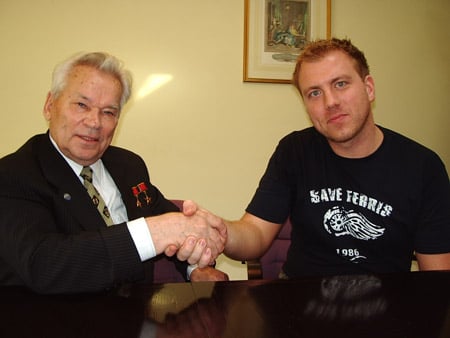
El Reg meets the general.
The ubiquitous AK has been seen as one of the most influential pieces of technology produced in the 20th century. People have made amazing claims for it: the Kalashnikov is said to have humbled US military and economic power, to have liberated the downtrodden and oppressed, to have changed the very face of warfare. Dozens of books have been written about the AK phenomenon, hundreds or perhaps thousands of articles.
Only one thing has been lacking in the AK discussion. That is, analysis from the debatable borderlands where technology, social phenomena and enormous, rumbling, erratically-researched commentary/analysis spitball articles collide: the land of Vulture Central. But today it shall lack no more.
The Nazis were arguably the first to field an assault rifle in significant numbers (See the Reg gun-dork primer here), but they dropped out of the picture in 1944. The Russians didn't: which is where Mikhail Kalashnikov and the AK47 come in.
By the end of World War Two, the Red Army had become enormous. Its millions of short-service, poorly trained conscript soldiers were largely armed with cheap submachineguns knocked out in a hurry. As the Soviets squared up to the Western powers, they knew that their troops – and those of their client nations – would need better weapons. They decided on an intermediate-power cartridge, so as to minimise costs and maximise capability. Having a very low level of marksmanship among their forces, they weren’t much concerned with accuracy or range.
The design they chose was the AK47, firing intermediate-poke Soviet 7.62mm cartridges, and it couldn't have fulfilled the requirement better. The AK could hit targets out to perhaps 200-300m. (AK47 sights are adjustable to 800m, later increased to 1000m on the AKM, but this is wildly optimistic.) The new weapon could spray bullets efficiently on full automatic, seldom suffering a stoppage. It was simple to strip and maintain, and worked pretty well even without any maintenance, covered in mud, dirt or rust. Best of all, it could be made very cheaply and easily.
COMMENTS
What's wrong with killing?
"The more I read The Register and Slashdot, the more I realise that there are a lot of sad prats out there who love guns. ... What a pathetic bunch of immature little boys, playing with guns and pretending that they're not designed to kill."
There's nothing wrong with killing people, as long as you kill the right people at the right time for the right reasons. That's why Tony Blair's bodyguard carried a handgun (having no legitimate use other than the killing of human beings). I personally know a man who was instructed by the British government to carry a loaded Glock 19 should the defense of the Royal family ever require him to kill people.
"Getting a little stiffy no doubt while you fondle the hard shiny barrel and ram home a clip/magazine, whatever."
Uh, oh! Looks like we have to report this guy to the government for hate speech against us on account of our sexual orientation. That's against the law, you know!
"It's articles like this, talking about these bloody things as though they're a work of art or a design icon that ensures we continue to remain at risk from the next inadequate who gets off on guns and kills someone."
Is it?
"But of course it'll be him not the gun. He could so easily have murdered people at random from a distance with any other kind of weapon couldn't he?"
I suppose he could use bows and arrows with poisoned tips. (He could even use a catapult to through dozens of poison-tipped darts. Or a doctor could just fill an automobile with shrapnel bombs and park it by a bar popular with single women (reflecting his understanding of the Hippocratic Oath).
"When the last Soviet troops left Afghanistan on Feb. 15, 1989, the vast arms infrastructure did not disappear. Operating for a decade, it had become ingrained in the economy and culture of Afghanistan and neighboring countries. ... the small village arms makers who bought, sold, repaired and produced their homemade versions (of the AK)"
Look on the bright side. If we can sufficiently promote the the spread of home-workshop arms-making techniques, maybe we can finally convince people that gun bans are no substitute for the killing of criminals, and that disarming the victims only makes things worse.
2007 is the year of the AK47 desktop..
Or was that last year ?
2 points
1 - Is that photo of Osma Bin Laden giving us the finger/flipping the biord (for american readers) real, and where did you get it? That's hilarious. It makes him look like some bored whiny teenager with a webcam.
2 - the argument that the development of the assault rifle was what helped the Vietnamese fight back the Amercians is flawed. Any nation that spent a millenium fighting back the huge nation to the north - China - would have the upper hand. A millenium of patriotic defense of the nation, the heavy jungle, and the local knowledge to turn any combat into close combat guerilla warfare meant they would always have won, or at least drawn. If the US handn't pulled out, it would still be ongoing.
MikeC

What you need to know about cloud backup
Agentless Backup is Not a Myth
Customer Success Testimonial: Recovery is Everything
Cloud storage: Lower cost and increase uptime
SaaS data loss: The problem you didn’t know you had