Mobile device mayhem, or...
Who decides?
SaaS data loss: The problem you didn’t know you had
In our recent mobile state of the nation survey, we asked you about what was important in a mobile device. In many respects, the results were pretty predictable in that, surprise surprise, battery life and decent voice capability were top of the list:
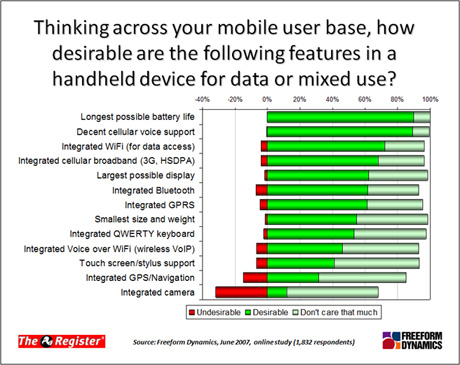
Quite a few then highlighted the importance of high-speed data access, whether WiFi or cellular based, with a fairly consistent shout beyond this for a reasonably sized display and basics such as integrated Bluetooth support.
As you work your way down the list, however, you get to features and functionality such as QWERTY keyboards, Wireless VoIP, etc, that appeal to some, with others not being that fussed. Then at the bottom we have a couple of items that not only appeal to a minority, but are actively not wanted by some people. Indeed, there are more people that definitely don’t want an integrated camera than want one, though the majority can’t get worked up either way.
This variation in demand for features begs the question of how organisations decide which of their mobile users are issued with which types of device – or even, whether the organisation decides at all, as there is clearly the option of leaving the decision in the hands of users themselves.
Against this background, we'd like to know how it works in your organisation. Which way do you lean on the freedom versus control thing and why? If you like to lock everything down, how do you decide which users get which devices? If you try to stike a balance, then what approach do you use - standard range of devices from which the user can chooose, or anything so long as it conforms to a certain spec or list of criteria? And how easy is it to enforce whatever policies you have in place given that users often think of their device as something very personal?
We know a lot of you have had to tackle the issues in this whole area, so tell us your experiences, good or bad, below:
Regcast training : Hyper-V 3.0, VM high availability and disaster recovery
COMMENTS
just exactly who...
...put decent cellular voice support down as undesirable??? i can to an extent understand why the other bits might be seen as undesirable, but surely crap voice support negates the whole purpose of having a PHONE?
Bankers *sigh*
I work for a penny-pinching financial organisation. As a result the only phones even considered are those that are EXTREMELY basic 2g (Nokia 2610 or worse) phones that don't even have good enough aerials for me to pick up signal in my lower ground flat in Glasgow despite having Vodaphone for an operator. The phones don't even have IR ports let alone bluetooth (I didn't even know such devices were still made!), so address book syncing is not possible (no data cable/software, either).
Thankfully I'm being made redundant, so I'll soon be able to actually read my Yahoo! mail at work again and use my own phone for business purposes without risk of office disturbance out of hours.
It would have been better to have your poll reflect common consumer items; most of the questions were aimed at work environment and on the basis of what the organisation is doing; these things are not the same at all.
Personally I really enjoy having a 2mp camera on my Nokia 6288 and I wouldn't own a camera otherwise. The OS was also a factor, as the OS on this phone sounds like it's without the troubles of Symbian, but also much better than on older Nokia phones I've used at work previously. Removable storage is a big must for me as well to keep those photos on and all my home-made mp3-based ringtones. The web stuff I could live without, although I would find 3's mobile mail useful for getting my Yahoo Mail on the go, my handset doesn't support it.
It's an investment
The decision to support mobile for key elements of the enterprise must be driven by need. You don't throw a data-storing communications device to any rank and file. If your IT staff, sales staff, writers at a newspaper, doctors, lawyers, investigators, etc. have a real need for mobile, if mobile offers a real business benefit, then you have to be willing to invest properly to support it. You also have to expect your employees to be adults -- if they're not, why are they working for you to begin with?
Well thought out policies have to be put in place, trained for and enforced with a reasonable amount of discipline. Camera? Sure, but with a rigid policy around that -- as long as the enterprise doesn't have large amounts of visually sensitive information, R&D, manufacturing processes, whatever that are relatively easily documented by a camera.. Bluetooth? Absolutely -- why not? Especially for headset use, GPS devices for staff on the road, so on and so forth. Headsets should in fact also be provided with any phone device. Again, some policy in place here, especially concerning transfer of data from company equipment to any mobile device or accessory. SDIO? I'd love to be able to lock it down, and/or be able to use strong encryption so that any company data that leaks onto an SDIO card only does so in an encrypted form. QWERTY keyboard? Sure, why not? Especially if the employee is sending/receiving a lot of company mail and/or text. At this point, all phones should be at least GPRS-capable, if not full 3G/HSPDA. Large screens should be available to any employee who spends time on the road, or needs to manage, massage or present any amount of data.
That said, many of these data-transfer policies apply just as equally to USB drives and MP3/multimedia players that also have the ability to store large amounts of potentially sensitive information.
I'm sure other presence-management/mobile-management suites offer similar capabilities, but one feature of note from the Vista/Exchange 2007/Office 2007 luncheon Microsoft gave a few months ago that interested me was the ability to remotely wipe the data on a phone in the event of lost data. I think this sort of capability is crucial -- terminated employees, stolen devices, I can think of any number of scenarios where being able to wipe the data on an MIA mobile device provides serious CYA insurance.

IT infrastructure monitoring strategies
What you need to know about cloud backup
Agentless Backup is Not a Myth
Top 10 SIEM Implementer’s Checklist
Steps to Take Before Choosing a Business Continuity Partner