
Asus EN8800 Nvidia GeForce 8800 Ultra-based graphics card
AMD who?
Review Nvidia has never been shy about slicing and dicing its product line-up to meet the needs of specific groups of the graphics-card buying public with the result that you can buy its flagship DirectX 10 GeForce 8800 chip in a number of versions.
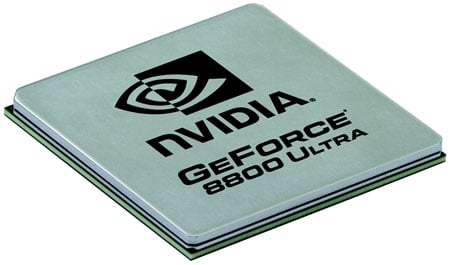
Nvidia's GeForce 8800 Ultra: GPU view
The bread-and butter version is the 8800 GTS with 640MB of memory and priced at £260, though there's a cheaper, bread-and-dripping variant with a mere 320MB of memory for £215. Move up the scale and you'll find the caviar-on-toast 8800 GTX with 768MB of memory that uses faster clock speeds and a larger complement of Nvidia's unified Stream processors to deliver top-notch performance for a hefty £380. And that, you might think, is that. However you'd be wrong.
Since its launch in November 2006 the GeForce 8800 GTX has been the fastest graphics card on the market, period. That's a considerable achievement when you consider the 8800 GTX is a DirectX 10 part that has been tested exclusively in a DirectX 9 environment for the simple reason that we don't yet have any DirectX 10 games. It's just as well because Nvidia hadn't quite sorted out its Windows Vista drivers when it launched the new chip, but happily that sorry situation is behind us. It's May 2007 now and we still don't have any DirectX 10 games, although Nvidia and Capcom have just made a demo of Lost Planet available for download in versions for both DirectX 9 and 10. You can get it here.
|
COMMENTS
you know what the sad thing is?
Most people will buy it, just because the games on the market considers their otherwise fine card "obsolete" and disables a bunch of features that the card could otherwise handle just fine. That, plus forced drivers obsolence. For example - my current linux box runs of a 2000-ish GeForce4 MX440 AGP. NVidia has recently stopped supporting drivers for the board, but since the legacy driver runs fine on it, no probs. But then, what will happen when Kernel 2.8 comes out a few years down the road and it's API changed, and the legacy driver stops compiling?
Jaded
I used to follow the "GPU Wars" religiously, ever since the Voodoo II hit the shelves, and was then challenged by the Riva TNT 128 (it's been so long, I'm not even sure I have the names right...)
But I lost interest after a while.
Firstly, the prices kept going up, and the release cycles shortened, to the point where the whole upgrade treadmill became rediculously expensive.
Secondly, the competition between ATI and Nvidia rapidly descended into self-parody.
And finally, the naming schemes got so complex I needed a look-up chart to know which chipset was faster than which, and by how much.
Is a GT faster or slower than a GTS? And a GTX? And what about the overlap with the previous generation? Is a 7600 faster or slower than a 6800? How does a 7800 GTSX5 Ultra Mega mk II rev B with Forceware 37.1.8.62C compare with the latest 8xxx?
Where's my lookup-table? Oops, it's out of date. They've release twelve new cards since it was printed, and they've also changes all the suffixes between generations. Now a GS means what MX meant last year, expect if we're talking DX9 performance, in which the MX is actually *better* than the GS, despite being older. Or something...
In the end, it sounds more and more like Scott Adams' idea of a "confuseopoly" - "a group of companies with similar products who intentionally confuse customers instead of competing on price". See http://en.wikipedia.org/wiki/Confusopoly (or http://en.wikipedia.org/wiki/The_Dilbert_Future)
Nice Try
Nice try NVIDIA, but my 8800GTX is clocked higher, and cost a lot less.
NiBiTor and NVflash FTW!
