


This article is more than 1 year old
Hatchling stars revealed in new Spitzer snap
Check out the polycyclic aromatic compounds on that one...

Gorgeous new pictures from the Spitzer space telescope show newborn stars "hatching" from the head of the Orion constellation.
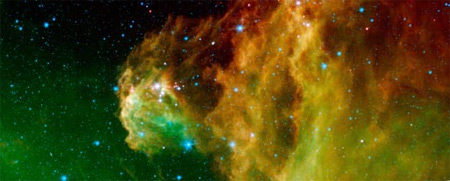
NASA says it is likely that the wave of star formation we are witnessing here was triggered by a shockwave from a star that exploded more than three million years ago.
The region in the picture is called Barnard-30, and lies around 1,300 light years from Earth.
As Spitzer is an infrared telescope, it can see through clouds of dust to reveal what lies beneath. It also means the image is false colour, each colour revealing more than would appear at first sight.
In this image, organic molecules called polycyclic aromatic hydrocarbons are tinted green. These molecules are formed any time carbon-based materials are burned incompletely: for example in the sooty exhaust from car and plane engines.
Dust particles that have been heated slightly by the newly formed stars have been coloured in orange-red, while new young stars take on a reddish-pink tone.
Blue spots throughout the image are background Milky Way stars along this line of sight. ®
 Biting the hand that feeds IT

