


This article is more than 1 year old
NASA scramjet goes for Mach 10 burn
Monday launch for third X-43A

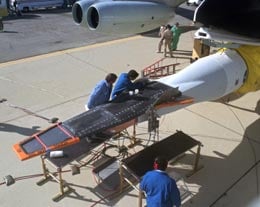 NASA's X-43A scramjet will on Monday undergo its third test flight during which scientists will attempt to push the vehicle to Mach 10. The X-43A is an air-breathing supersonic ramjet, which ducts air directly from the atmosphere, mixing it with hydrogen before combustion. The forward speed of the vehicle provides compression, thereby eliminating the need for conventional jet engine turbines. The speed of the airflow through the engine remains supersonic throughout.
The programme has not been without its hiccups. On 2 June 2001 the first X-43 flight ended in disaster when the vehicle self-destructed shortly after ignition of the Pegasus booster rocket intended to accelerate the X-43A to a sufficient velocity for the scramjet to kick in (roughly Mach 5-6). A faulty Pegasus was later fingered as the culprit. On 27 March 2004, however, the second X-43A successfully reached Mach 7 for an independent flight of 15 miles.
NASA has reportedly made a some modifications to the X-43A in anticipation of its latest outing, notably to the wing leading edges and nose in anticipation of temperatures of up to 2000°C generated by the tremendous speed - considerably greater than the 1400°C which toasted its snout during the Mach 7 trial.
The X-43A and Pegasus have already been hitched under their B-52 launch aircraft, and the NASA team hopes that - weather permitting - the test will go ahead off the coast of Southern California at around 1pm Pacific Time on Monday 15 November. The flight will mark the last scramjet test for the time being, since NASA has yet to commit extra funds for continued research into scramjet powerplants for its Hyper-X programme, designed to examine fast future transport systems. ®
Related stories
NASA scramjet hits Mach 7
NASA scramjet probe hots up
NASA scramjet crashes and burns
 Biting the hand that feeds IT

